
In This Article
The AI purity test can be identified by those who have seen the checklist that features boxes for “Used AI to write a resume” or “Fell in love with a chatbot.” It’s the internet’s latest self-scoring quiz, and if you’ve already taken it and are sitting there wondering whether your score means you’re a productivity genius or a lost cause, you’re in the right place to understand your AI usage habits
Quick heads-up before we dive in: there are actually two different things called an “AI purity test” floating around online. One is the checklist quiz we’re talking about here an AI self-assessment quiz that’s really a fun, personal audit of your AI habits. This one is the other which is the detection tool used to see whether a document has been written using AI, not the tool to check whether you use AI. In case you got here because you were looking for the latter, then what you need is an AI content detector. Everyone, keep reading.
What Is the AI Purity Test?
The AI purity test is an AI self-assessment quiz a self-graded checklist, usually around 100 items long, where you tick off every AI-related thing you’ve done. It starts innocent “heard of AI,” “used a chatbot” and gets progressively more specific: “used AI tools for learning and productivity” “hidden your AI usage from colleagues,” “been engaged to an AI chatbot.” Yes, that last one is a real item, and yes, it’s based on an actual news story.
The format isn’t new. It’s a direct descendant of the Rice Purity Test, a checklist that started at Rice University in the 1920s to survey students about drinking, dating, and other “vices,” and eventually went viral on TikTok as a nostalgia-tinged rite of passage. Someone,a New York-based writer and coder named Tina Tarighian — took that same structure and pointed it at AI instead. A couple of near-identical versions have popped up since, but hers is the original.
None of this is scientific. It’s not measuring your intelligence, your ethics, or your career prospects. It’s a mirror, not a report card and that framing matters more than it sounds like it should, because a lot of people take one look at a low score and start spiraling.
How the Scoring Actually Works
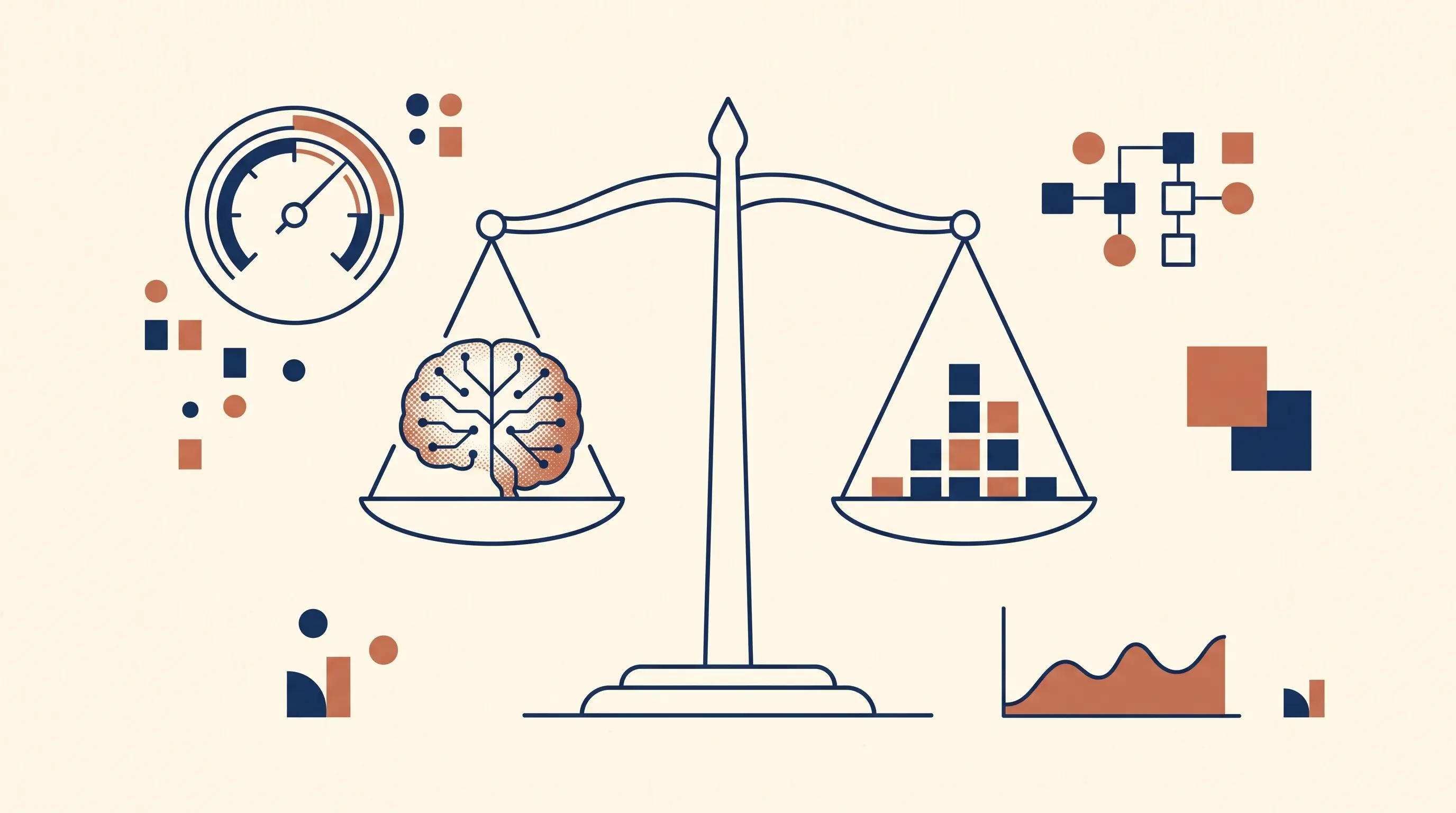
The mechanics are simple: every box you check knocks a few points off your total. Check nothing, you’re at 100% “pure.” Check everything, you’re at 0%. The questions are grouped into rough categories basic awareness, everyday usage, dependency, social use, ethical gray areas, and advanced/technical use and most versions of the test show you a breakdown across those categories, not just one final number.
That breakdown is actually more useful than the overall score. Someone who scores 60% because they’ve dabbled across every category tells a different story than someone who scores 60% because they’ve maxed out “dependency” but never touched anything ethically dicey. The single percentage flattens that nuance, so don’t stop reading at your headline score look at which category is dragging you down (or up). Thus, to sum up, the classification aims to illustrate a more detailed view of your AI habits compared to just one number.
What Your Score Actually Means (By Range)
This is the section that everyone really wants to know about, but what most tests of this kind miss out on entirely: what does all of this mean? 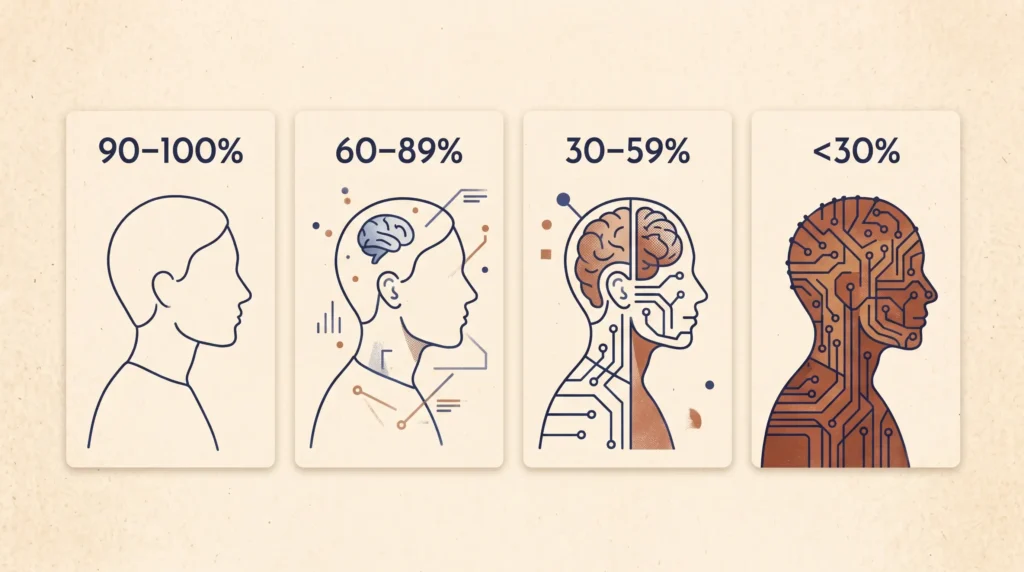
90–100%: You’ve barely touched AI. This usually means you’ve heard of ChatGPT, maybe poked at it once, and moved on. If you’re a freelancer or small business owner in this range, you’re probably not using AI tools that could save you hours a week — worth a second look, not out of pressure, just curiosity.
60–89%: Casual, everyday user. This is where most learners and freelancers land. You may have already employed AI for brainstorming, email writing, or homework assistance, but it isn’t a part of your everyday life yet. Totally normal, and honestly the most common bracket by a wide margin.
30–59%: AI is part of how you work. Startup founders and small business owners tend to cluster here — using AI for first drafts, customer replies, research, maybe some coding help. This isn’t a red flag. It’s what “using your tools well” looks like in 2026. The category breakdown matters a lot here: heavy “usage” plus low “ethical” concerns looks very different from heavy usage plus a lot of undisclosed AI content going out under your name.
Below 30%: AI is deeply integrated into your life. A handful of items on this test are genuinely extreme outliers — checking “fell in love with a chatbot” or “used AI to make a key decision without verifying it” pulls your score down fast even if the rest of your habits are ordinary. A low score isn’t automatically a problem. It’s a prompt to ask which items pulled you down, and whether those specific habits are working for you or quietly running your life.
The point of all this: there’s no “good” score. There’s only an honest one, and what you decide to do with the information.
Why This Quiz Is Going Viral Right Now
This test didn’t blow up in a vacuum. It landed at a moment when everyone students, freelancers, business owners is quietly trying to figure out where the line is between “using a tool” and “outsourcing a piece of yourself.”
Look at the news items the test itself cites for inspiration: a general using ChatGPT to help make military command decisions, a woman getting engaged to an AI chatbot boyfriend who picked out her own engagement ring, wedding vows written with AI assistance, an AI chatbot allegedly playing a role in someone’s psychiatric crisis. These aren’t hypotheticals dreamed up for shock value they’re real stories from the past year, and the test compiles them into a checklist so you can see where you personally sit on that spectrum.
Before You Share Your Score, Read This
Here’s something almost nobody talks about: some of the items on this checklist are genuinely sensitive. We’re talking about questions involving crime, drug and weapon instructions, mental health crises, and relationships with AI that go well beyond casual use.
Most versions of the test let you share a link or post your result straight to social media or even “add it to your dating profile.” Before you do that, think about what you’re actually sharing. Posting “I scored 45%” tells people almost nothing specific. Posting a screenshot of every box you checked can reveal a lot more than you meant to especially if a future employer, client, or date happens to scroll back through it.
What to do in practice: You can share your total score if you wish, but you definitely don’t have to provide a screenshot by box. No harm will be done to your enjoyment of the process.
What Your AI Habits Say About Your Work (For Freelancers and Small Businesses)
If you run a business or freelance, a handful of the “dependency” items on this test are things you should feel completely fine about. Using AI to draft proposals, summarize research, or handle first-pass customer replies isn’t a compromise it’s a legitimate way to get more done with fewer hours in the day. Plenty of successful small business owners lean on AI tools daily and would score “low” on this test while running a perfectly healthy business.
The line worth paying attention to isn’t how much you use AI — it’s where you stop checking its work. Sending an AI-drafted email after a quick read is fine. Sending AI-generated legal or financial guidance to a client without verifying it yourself is where real risk creeps in. Same goes for letting AI-written content go out under your business’s name without a human pass — not because AI writing is inherently bad, but because your name is the thing on the line if it’s wrong.
A simple gut check: if an AI tool got something wrong in what you just sent out, would you have caught it before it went out the door? If the answer’s yes, your AI habits are probably serving you well regardless of your score.
A Healthier Way to Think About Your Score
Don’t regard a poor result as an issue that requires solving. The term “purity” makes the usage of AI sound as a sort of moral assessment. However, one’s reliance on AI does not make anyone incompetent, creative or incapable. It only means making use of the tools which one possesses and applying them to simplify their work, like using a calculator or spellchecker does.
AI purity test results should be considered as a reflection of the individual’s AI practices, but not as an indicator of intelligence, morality or capabilities of the individual. A poor result does not automatically imply that one is overly reliant on technology. What is important is how consciously an individual uses AI and whether he or she stays engaged in the work it assists them to accomplish.
In the end, AI purity test results are merely numbers. These numbers might give you an idea of the way you work with AI, but they do not tell anything else about you. The real value of the test lies in making use of the knowledge it gives to develop healthy AI habits.
Is the AI purity test scientific?
Is the AI purity test scientific?No. This is only a reflection tool and not a psychometric tool that can be used clinically. Just take it for what it is, as you would any “Which decade do I belong to?” type of quiz.
Who made the AI purity test?
The original was created by Tina Tarighian, a New York-based writer, artist, and coder. A few near-identical versions have since appeared on other sites.
Is my data private when I take it?
Most versions store your answers locally in your browser rather than sending them to a server, and nothing is shared unless you actively choose to post or copy a link. Still, always check the specific site’s privacy note before you take it — not all clones handle data the same way.
What’s a “good” score?
There isn’t one. A high score just means low AI usage; a low score means high usage. Neither is inherently better it depends entirely on whether your specific habits are working for you.
Is this related to the Rice Purity Test?
Yes, directly. It borrows the same checklist format and 100-question structure that made the Rice Purity Test a long-running college tradition, just aimed at AI behaviors instead of typical “vice” behaviors.
What’s the difference between this and an AI content detector?
This test measures your personal AI usage habits through self-reporting. An AI content detector (like the tool Substack recently added) analyzes a piece of writing to estimate how much of it was AI-generated. Different tool, different question, same borrowed name.