

In This Article
Imagine you start using an AI tool to sort job applications. A few weeks later, you notice something strange. The people it picks all look very similar. You never told it to do that. So what happened? That problem has a name: AI bias. You may also see it called algorithmic bias, artificial intelligence bias, or machine learning bias. They all point to the same issue. An AI system gives less accurate or less fair results for some groups of people than for others.
When can estimate the AI bias in chat bots, hiring tools, loan approvals, healthcare risk scores, loan approvals and face recognition. Mostly it happens in the process of training data, from where AI gets the required information. If the data contains the old biased patterns then the results will be in form of AI bias.
Bias can also sneak in through data labeling (people tagging data so the AI knows what it is looking at), through proxy variables (a stand in measure, like past medical spending used to guess how sick someone is), and through the goals the builders choose. At the end of the chain, automation bias can add more harm. That is our habit of trusting a computer’s answer too much.
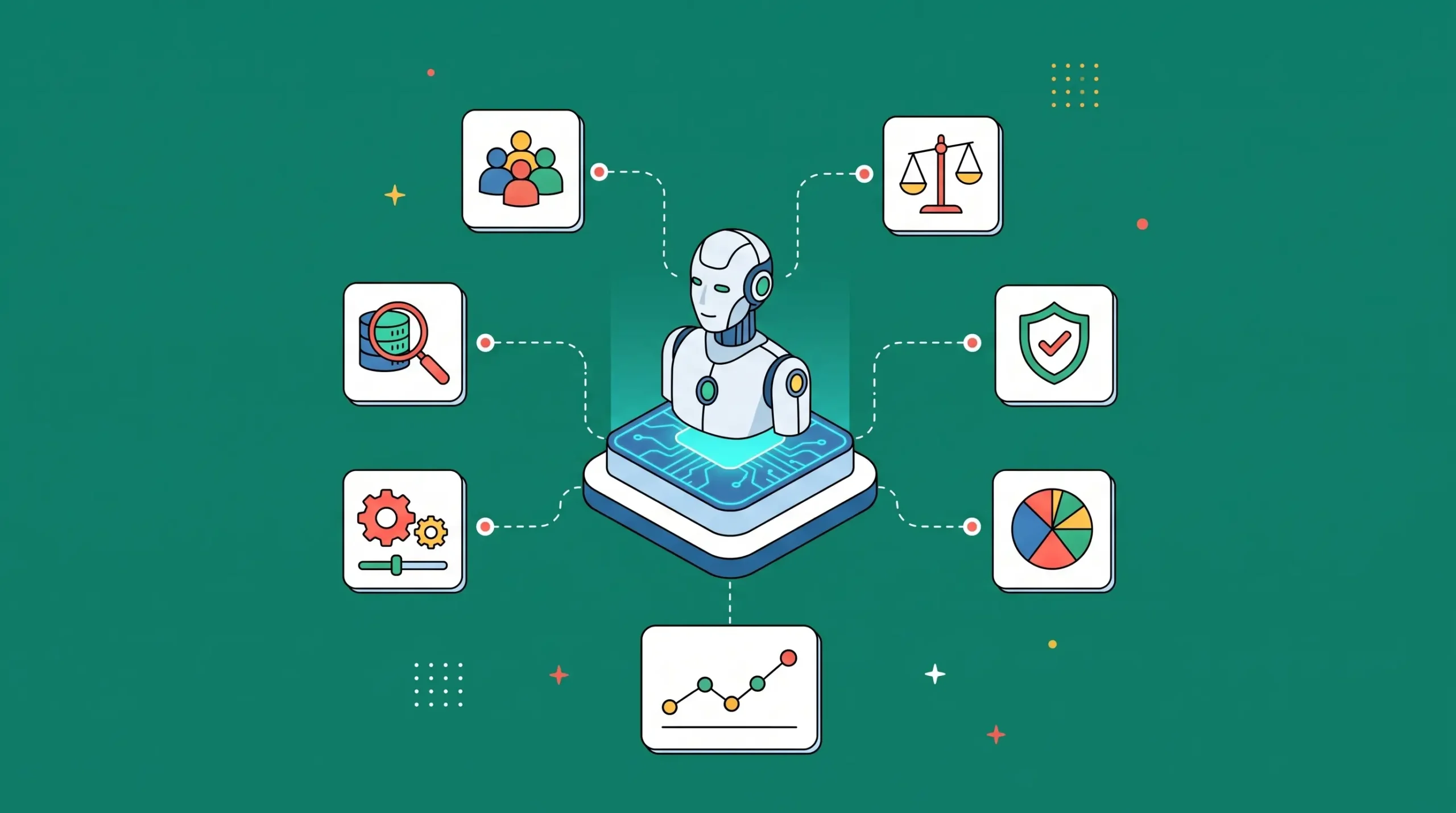
The good news is that bias can be reduced. AI bias mitigation strategies are the practical steps that find unfair results and bring them down. They work at every level:
- Data: wide range of data collection, assign proper weights, and high dimensional data sets.
- Models: fairness aware training, adversarial de-biasing (two models compete so the main one stops leaning on sensitive details), and counterfactual testing (changing one detail, like a name, to see if the result changes).
- Results: adjusting decision cutoffs and adding output filters.
- People: human in the loop review, diverse teams, and appeal options.
- Rules: For AI governance rules are made clearly, audits, and updated the monitoring process.
What Is AI Bias? (Types Explained Simply)
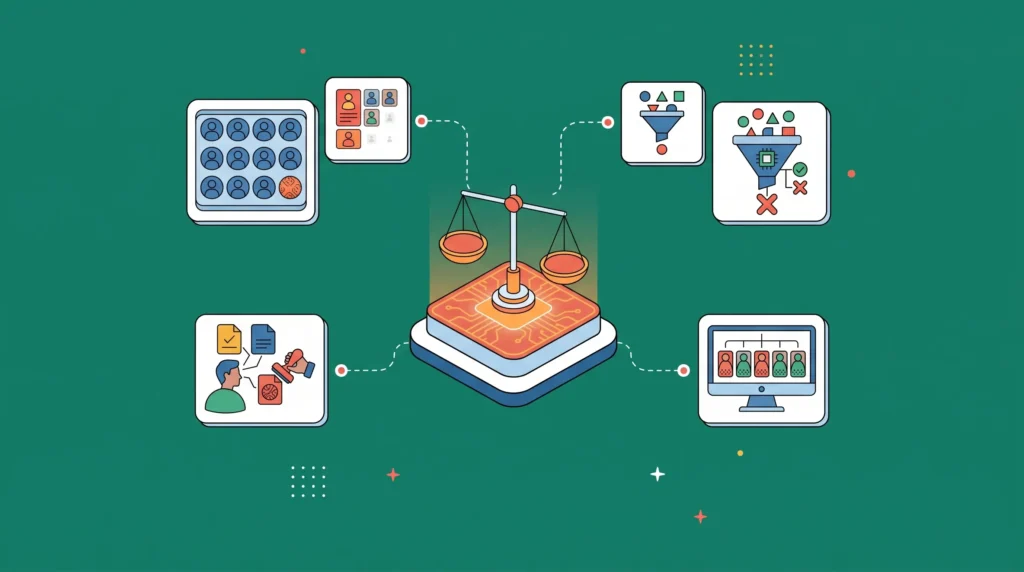
AI bias means an AI system treats some groups unfairly or works worse for them. The AI does not want anything. It learns patterns from data made by people, so it picks up the unfair patterns people leave behind.
Here are the main types: Type What it means Simple example Data bias Training data leaves out some groups or reflects past unfairness A skin cancer tool trained on photos with very few dark skin tones Algorithmic bias Systematically favors some outcomes A model built only to be as accurate as possible overall, so it ignores who it gets wrong Human bias People usually collecting, labeling, or designing according to their choice Labelers tagging images with stereotypes Generative AI bias The text and images are repeatedly built into chatbots and image tools A tool that links certain jobs mostly with one gender
How to Spot AI Bias Before It Causes Harm
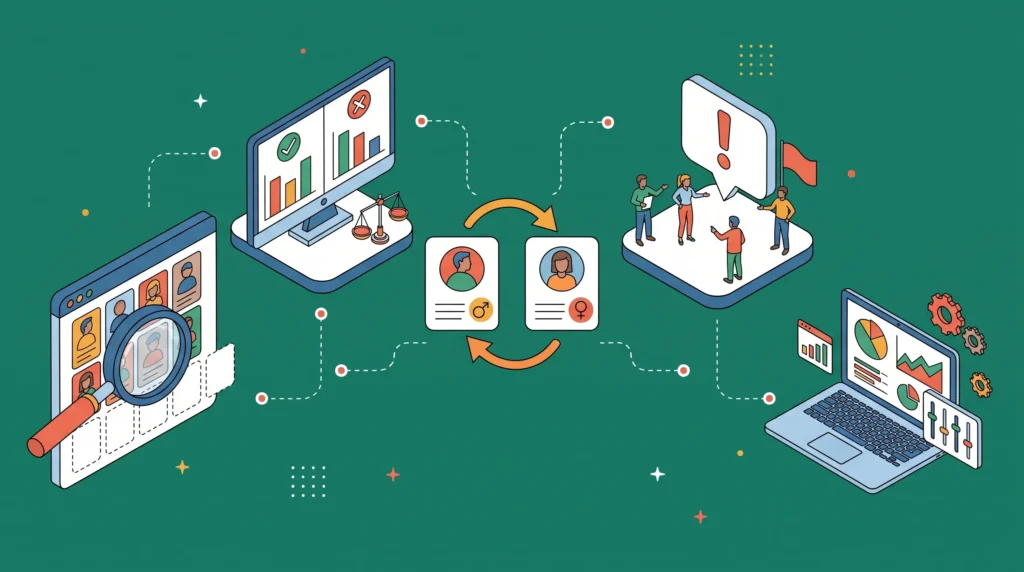
The first thing to Check the results across different groups.Make sure the used tool gives results differently for same category of samples.Here is how to check.
- Look at your data. Who is included? Who is left out? Compare the demographics in your dataset to those served by the tool.
- Compare results by group. Review approval rates, rejection rates, and error rates for all groups. One aggregate figure of accuracy masked this problem.
- Run a swap test. This is counterfactual testing in layman’s terms. By leaving everything constant except one or two variables such as, name or gender and seeing a difference in outcome means that factor was influencing decisions, and it shouldn’t have.
- Listen to users. Have users easily flag problems. Some of the most effective bias reports have come from the very individuals impacted.
- Use free tools. Fairlearn and AIF360 are both open-source tool kits for calculating fairness metrics on a per-group basis. They require some Python coding skills. For smaller projects, a simple spreadsheet of group outcomes is sufficient.
A common trap: However, hiding sensitive information will not help solve the problem. Numerous groups delete race or gender from the database and think that the problem is solved. In case you are collecting sensitive information for testing purposes, be very cautious.
AI Bias Mitigation Strategies You Can Use
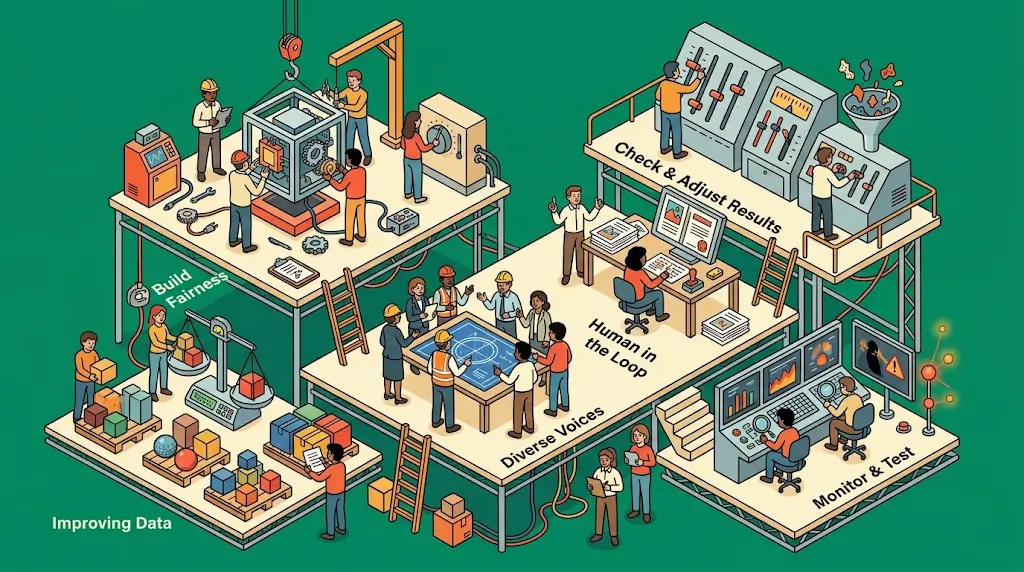
There is no way to eliminate biases entirely. This is acknowledged explicitly in the Berkeley Haas playbook. The objective is to minimize biases, monitor frequently, and rectify errors. Here are the strategies listed in the sequence that an AI project would follow: pre-training, during training, post-training, and lastly, people and audits. Each strategy comes with the condition when it can go wrong.
Strategy 1: Improve Your Data (Before Training)
The best way to proceed is to improve the quality of data first since all subsequent steps rely on it.
- Coverage assessment. Does your data represent the types of groups, locations, and scenarios that your model will encounter?
- Rectify labeling errors and unclear categorization.
- Rebalancing. Re-weighting ensures that underrepresented classes get greater weight during training.
- Gather additional data.
When it can backfire: Synthetic data bridges these gaps using computer-generated data. There is a process known as SMOTE which does this through combining actual examples. Synthetic data is known to lack diversity from the real world and reinforces existing bias.
A myth to skip: Both federated learning, where learning takes place on multiple sites without centralized data collection, and differential privacy, which involves adding noise to make individual identification impossible, ensure privacy. However, they do not correct bias by themselves. This is highlighted in the Nature review since federated learning makes data validation difficult.
Strategy 2: Build Fairness Into the Model (During Training)
Set a fairness goal at the start and track it next to accuracy.
- In fairness aware training, the model is penalized when results differ too much between groups.
- In adversarial debiasing, a second model tries to guess a sensitive trait from the first model’s work. The first model learns to stop leaning on that trait.
- Fairlearn and AIF360 include ready made versions of these methods.
- Prefer simpler models when you can. They are easier to explain, which means you can see why the model gave a result. That is called explain ability, and it makes bias easier to catch.
When it can backfire: The fairness and accuracy trade off. Making results fairer can lower overall accuracy a little. Decide ahead of time how much you are willing to trade and write it down.
Strategy 3: Check and Adjust the Results (After Training)
Post-processing is where you can address issues at the output level as well.
- Modify decision thresholds to ensure that mistakes are equally distributed among different demographics.
- Implement filtering. For instance, in the case of a chatbot, it would be able to filter out offensive responses.
When it can backfire: Implementing different decision thresholds for different demographic groups may have legal implications in some jurisdictions. It is recommended to consult with your legal advisor on this matter first.
Strategy 4: Keep Humans in the Loop
- Human in the Loop is about having a human validate critical output prior to taking any action on it. Use Human in the Loop for anything that will have an impact on someone’s life, such as hiring, loaning, and medical decisions.
- Humans can bring their own bias as well. The Nature review mentions automation bias in two ways. People may be blind to errors in AI output or follow the AI recommendation despite contradictory data. Also mentioned is alert fatigue, where people ignore the warnings of the system because of too many false positives.
- Explain to the reviewer the logic behind the AI’s output.
- Train the reviewers to critically evaluate it.
- Allow those affected by this process to appeal to the human in the loop. Berkeley Haas playbook suggests doing this.
Strategy 5: Bring in Different Voices
People with different backgrounds notice different problems. The Berkeley Haas playbook adds that diversity alone is not enough. Teams also need people from fields like social science and people who know the subject area well.
No budget for a big team? Try these:
- Invite a few real users from the groups your tool serves to test it.
- Ask a friend or colleague in the field to look for problems.
- Pay for a one time outside review of your riskiest tool.
Strategy 6: Test Before Launch and Keep Watching After
However, bias can recur as the world changes.
- Always conduct a pilot test first.
- Consider using shadow mode. Here, the AI operates silently next to your standard process without influencing decision-making, allowing you to compare outcomes objectively.
- Check for concept drift. This happens when the world around you changes enough that the patterns the AI recognizes are no longer relevant.
- Set an alert threshold. In other words, define in advance the acceptable disparity among groups. As per the Nature review, you should do so in advance.
- Schedule reviews monthly or quarterly, and whenever there is any change in your data or model.
Where to Start
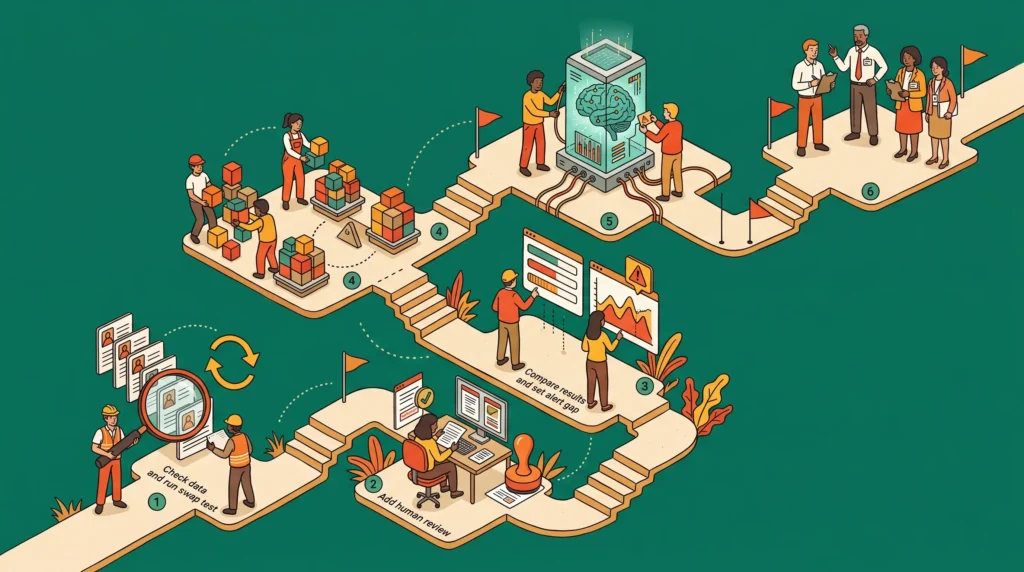
Not sure what to do first? Use this order. Priority Action Effort Cost 1 Check who is in your data and run a swap test Low Free 2 Add human review for high stakes decisions Low to medium Staff time 3 Compare results by group and set an alert gap Medium Free tools 4 Rebalance or improve your data Medium to high Varies 5 Add fairness aware training High Needs technical skill 6 Get an outside audit High Paid
How to Measure Fairness (Simple Fairness Metrics)
A fairness metric is a number that shows whether a system treats groups equally. Here are three common ones. Metric What it means Example Demographic parity Each group gets the good outcome at a similar rate A loan tool approves about 40% of applicants from every group Equal opportunity Among people who truly qualify, each group has the same chance of being approved Qualified candidates from every group are equally likely to reach an interview Equalized odds Both the missed qualified people and the wrongly approved people appear at similar rates across groups A medical test misses illness and raises false alarms at similar rates for every group
This is where the truth lies. Fairness can mean different things, and a system is unable to be fair in all of those ways at once. According to the Berkeley Haas playbook, models can only meet several fairness criteria simultaneously. The Nature review explains that treating all individuals equally does not always make a decision the most fair decision, as sometimes certain groups require more support to benefit equally from an opportunity.
So choose the metric that corresponds to the type of harm you consider important. They are only guidelines, not strict criteria.
- Hiring filters: equality of opportunity, so qualified candidates of each group pass them.
- Medical and safety technologies: equalized probabilities, so errors would not be accumulated by one group.
- Advertising for jobs, accommodation or loans: demographic parity, so every group would receive an opportunity.
Record what metric you have chosen and why. This record will come in handy later.
Bias in Chat bots and Language Models
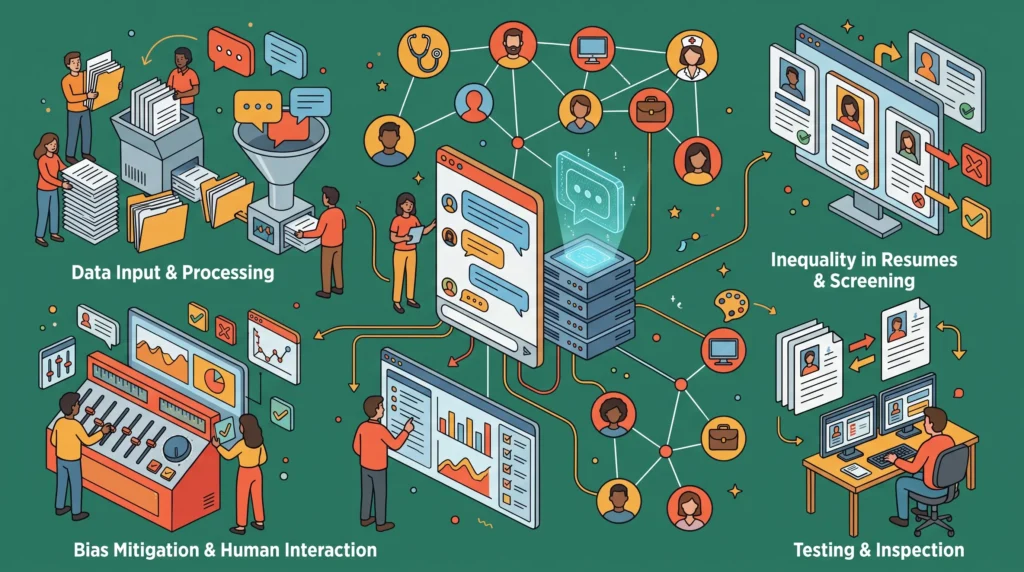
Large language models train on vast volumes of natural-language texts produced by humans. The texts include stereotypes, which may be reproduced by LLMs. As per the Berkeley Haas playbook, there is an academic work about research on word embeddings (representation of words by means of numbers so that computers can compare them). It showed that the occupations such as nurse or homemaker were more often associated with women than the occupations such as doctor or computer programmer.
The effect is not only theory. In 2024, researchers at the University of Washington tested three open-source models for text embedding, which are an LLMs that convert the documents to numerical form so they can be compared. They used these models to rank resumes against job descriptions, performing more than 3 million evaluations. In 27 different bias tests, the White associated names performed better 85% of the time, while the female associated names won in just 11%. The Black male names performed the worst among the candidates. The White male names won in all 27 tests. The findings were released during the AAAI/ACM Conference on AI, Ethics, and Society. This model is not a chatbot such as ChatGPT, however, it belongs to the same category. Representatives of two of the companies stated that the models were not intended for use in the hiring process.
Run a mini swap test on any AI tool
- Take any resume, cover letter or customer email.
- Create multiple copies of it where there is only one difference; the name.
- Get the AI to analyze/rank/respond to each copy in an identical manner.
- Repeat this process multiple times since AI responses can be inconsistent.
- Comparing the outcomes will help determine whether there is any bias if the results change based on different names.
How to reduce bias when you use these tools
- Use clear prompts. Be sure to seek a balanced answer, and let the machine know what information you want it to disregard, like names.
- Always avoid using chatbots as the sole arbiter in hiring, lending, and grading.
- Pre-review any content created by the tool before publishing it. Similarly, image-based tools also perpetuate biases and stereotypes.
- Know what kinds of testing vendors have done on their tools, in relation to bias, with respect to which groups, and for what purposes.
- Conduct limited red-teaming, where your aim is to purposely break down the algorithm’s integrity. Get some volunteers and test the tool with tricky prompts.
AI Governance and Monitoring for Small Teams
AI governance may appear to be a very complex concept, but it actually refers to straightforward guidelines as to who is to blame in the case of an error. Such guidelines can be made by a tiny group of people in one afternoon.
- Name an owner. Someone has to be in charge of doing the fairness tests.
- Write a one-page policy. Discuss which AI tools you use, what decisions they affect, and what tests you perform.
- Document yourself. Document your data sources, tools version, and the fairness measure you use.
- Be transparent about your limitations. According to the Berkeley Haas playbook, it is good to state clearly the limitations of your system.
- Schedule regular reviews. Perform tests at certain times, not just in response to complaints.
- Make it easy to report. Give the users and employees an easy method for reporting issues.
Your One Week Action Plan
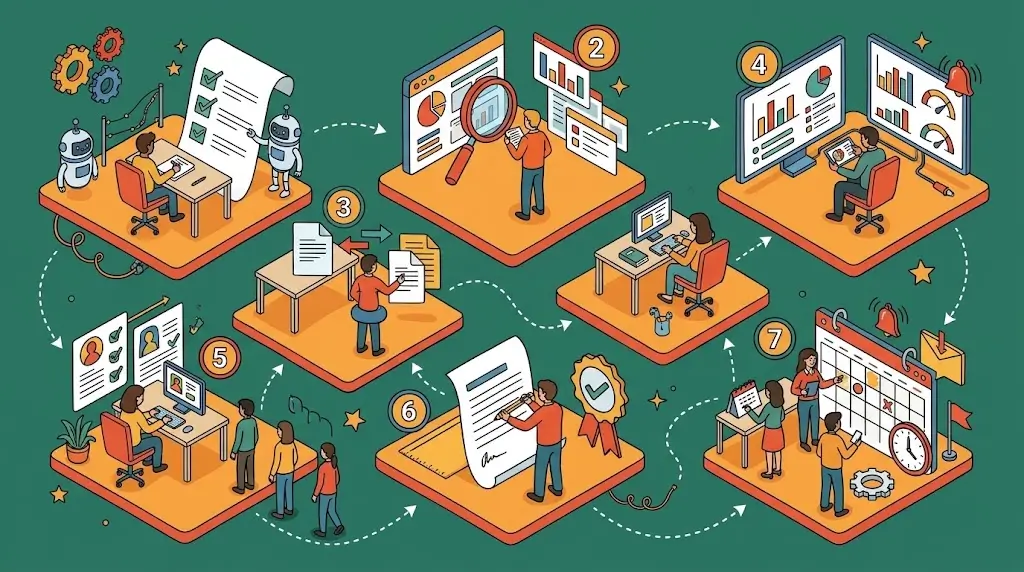
- Day 1: Make a list of all the places where you deploy AI with human impacts.
- Day 2: Look at your data. Who is covered, who is not?
- Day 3: Conduct a swap test on your most important application.
- Day 4: Compare outcomes across groups. Select a metric for fairness and an alert threshold.
- Day 5: Add human oversight and an appeals process for high-stakes decisions.
- Day 6: Draft your one-page policy and appoint an owner.
- Day 7: Set up review intervals and a mechanism for reporting issues.
Texora Verdict
AI bias cannot be erased, but it can be reduced with steady habits. Start with three moves. Check who is in your data. Run a swap test. Keep a human in charge of high stakes decisions. Then add fairness metrics, regular monitoring, and simple governance as you grow.You do not need a big team to do this. You need curiosity, a few free tools, and the willingness to ask who might be left out.
What is AI bias mitigation?
AI bias mitigation refers to the procedures employed in detecting and mitigating the presence of bias in AI systems. These can be applied to data, models, outcomes, individuals, and governance. This is a continuous process and not a single intervention.
Can AI bias be completely removed?
No. According to the Berkeley Haas playbook, eliminating AI bias is not possible. The only thing one can do is to minimize, measure, and monitor the existing bias.
What are the main types of AI bias?
There exist several types, including data, algorithmic, human, and generative AI biases. Every form can emerge during different stages of an AI system’s life cycle.
How do you reduce bias in machine learning?
First, collect high quality and balanced data. Ensure there is a focus on fairness during training, adjust the outputs where necessary, maintain human involvement when making important decisions, and perform regular testing after deployment.
Can small businesses reduce AI bias without a data scientist?
Yes. Perform swap testing, use spreadsheets for outcome comparison between different groups, include human reviews, and seek information about bias detection measures from vendors. These processes require no coding.
Are ChatGPT and other chatbots biased?
They might be since they learn from texts written by humans containing biased stereotypes. To test these tools, carry out swap tests, draft proper prompts, and review their outputs.
What tools can help detect AI bias?
Fairlearn and AI Fairness 360 (AIF360) are free, open-source toolkits designed to detect and mitigate biases. For quick and easy testing, a spreadsheet comparing the outcomes for different groups will do the job.