

In This Article
The tunnel is loud. The favorites walk out first. Cameras follow every step, every expression, every superstar. Then, almost unnoticed, another team emerges. Less celebrated. Less discussed. Usually underestimated.
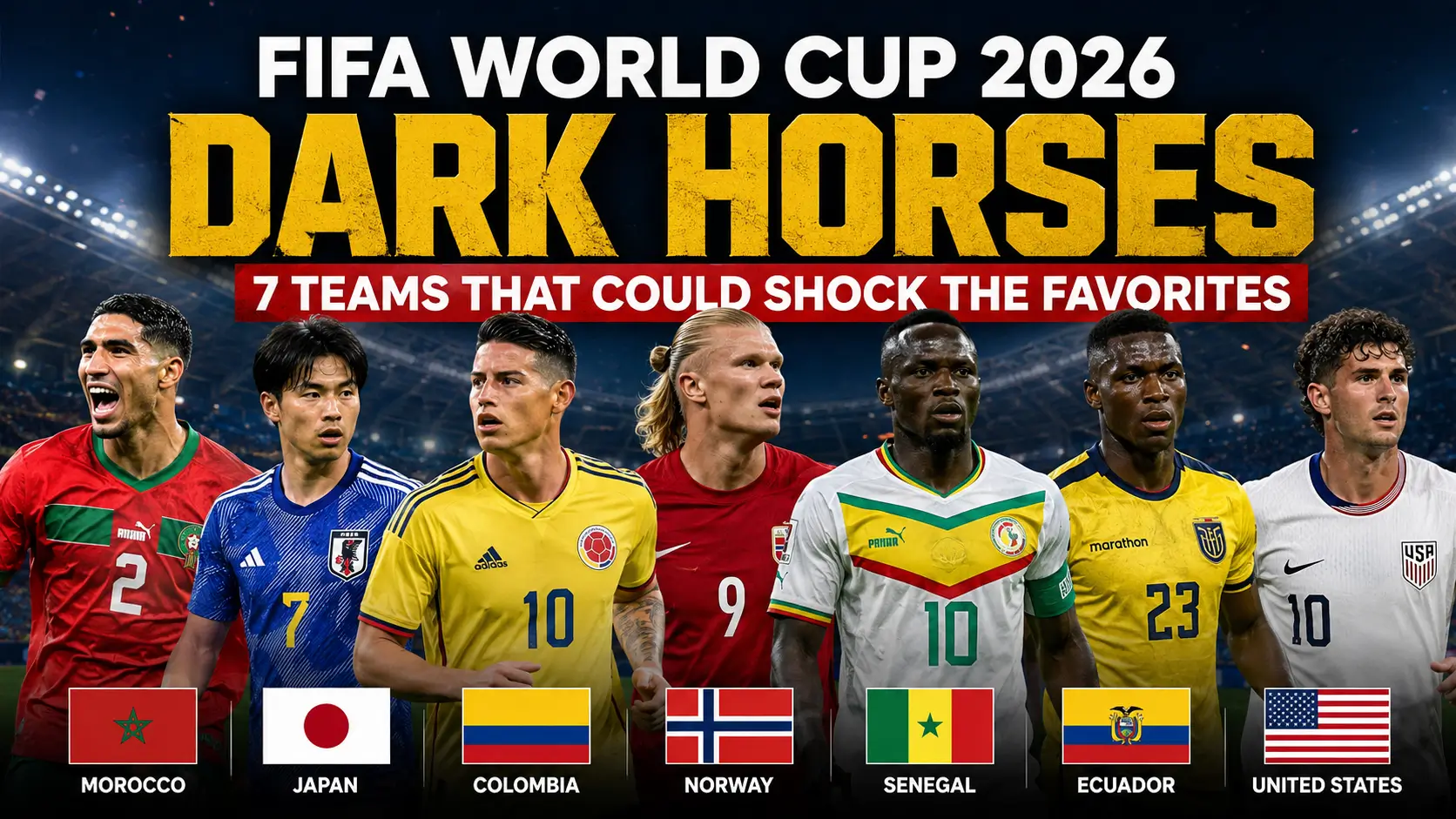
That is where the story of every FIFA World Cup 2026 dark horses candidate begins.
History rarely remembers who topped the betting markets six months before kickoff. It remembers the teams that disrupted expectations. Croatia in 2018. Morocco in 2022. South Korea in 2002. None started as the obvious choice. All changed the tournament.
The expanded 48-team format creates even more room for surprises. More nations qualify. More knockout places exist. More opportunities emerge for tactical discipline, defensive structure, and momentum to outweigh individual star power. The conversation around FIFA World Cup 2026 dark horses is no longer a side topic. It may become the defining storyline of the tournament. The expanded format allows the top two teams from each group plus the eight best third-placed teams to reach the knockout stage, increasing upset potential significantly.
What Makes a FIFA World Cup 2026 Dark Horse?
A true dark horse is not simply an underdog.
The team must possess enough quality to survive multiple knockout rounds while remaining outside the group of traditional title favorites.
Several traits usually appear:
- Tactical consistency
- Defensive compactness
- Set-piece efficiency
- Squad continuity
- Elite transition play
- A goalkeeper capable of stealing matches
World Cups reward structure more than spectacle.
Over seven matches, organization often beats reputation.
Morocco: The Blueprint Already Exists
Few teams enter the FIFA World Cup 2026 dark horses discussion with stronger evidence than Morocco.
Their semifinal run in Qatar was not built on luck. It was built on spacing, discipline, and relentless defensive coordination. Opponents regularly found themselves forced into wide areas where Morocco’s defensive block compressed space and eliminated high-quality chances.
The current generation remains largely intact.
More importantly, Morocco no longer carries the psychological burden of proving it belongs. The team now speaks openly about targeting another deep run rather than celebrating participation. Recent comments from the squad indicate ambitions extending beyond their historic 2022 semifinal appearance.
Why Morocco Can Shock Favorites
The defensive structure remains among the best outside the elite contenders.
When possession is lost, recovery distances are short. Midfield support arrives quickly. The entire system is designed to deny central penetration.
Against technically superior teams, that matters.
A lot.
Japan: Precision Over Star Power
Japan continues to evolve.
What separates this generation from previous versions is tactical maturity. The team no longer relies exclusively on energy and work rate. It now combines those qualities with positional sophistication.
Their pressing triggers are carefully coordinated. Wide players collapse inward when possession changes. Fullbacks advance aggressively without exposing defensive balance.
How Does Japan Beat Bigger Teams?
Japan rarely attempts to dominate possession against elite opposition.
Instead, they create overloads in transition.
A turnover becomes a scoring opportunity within seconds. The first pass after recovery is often vertical. The second pass usually breaks a defensive line.
That approach already produced famous World Cup victories in recent tournaments.
There is no reason it cannot happen again.
Colombia: South America’s Most Dangerous Outsider
The FIFA World Cup 2026 dark horses conversation often overlooks Colombia because the spotlight usually falls on Argentina and Brazil.
That creates opportunity.
Colombia possesses one of the most balanced squads outside the continent’s traditional powers. Their midfield combines technical quality with physical intensity. Their defensive shape remains compact. Their counterattacks are direct and efficient.
What makes Colombia especially dangerous is adaptability.
Some teams need one game script.
Colombia can win several ways.
They can control possession. They can defend deep. They can survive ugly matches.
Tournament football rewards flexibility.
Norway: Finally Ready for the Global Stage
For years, Norway had elite individuals without a complete team.
That equation has changed.
The presence of world-class attacking talent naturally attracts attention, but the more important development is structural improvement throughout the squad. Norway’s qualifying consistency has reflected a level of organization often missing from previous generations.
What Makes Norway a Legitimate FIFA World Cup 2026 Dark Horse?
Their attack forces opponents into difficult decisions.
Defend high, and Norway attacks space behind the back line.
Defend deep, and creative midfielders gain more time to dictate play.
Few dark horses possess a genuine game-changing striker. Norway does.
In knockout football, one moment often decides everything.
That matters more than most metrics.
Senegal: Athleticism Meets Tactical Discipline
African teams have frequently possessed talent.
The challenge has often been consistency.
Senegal appears better positioned than most predecessors.
Their squad combines physical power with increasing tactical sophistication. Defensive transitions are cleaner. Midfield spacing has improved. The team remains dangerous on set pieces and direct attacks.
Why Senegal Can Reach the Quarterfinals
Knockout matches frequently become physical contests.
Senegal thrives in those conditions.
Their ability to contest second balls, recover quickly after turnovers, and maintain defensive intensity deep into matches makes them uncomfortable opponents for possession-heavy favorites.
No favorite wants a difficult Round of 32 matchup.
Senegal could become exactly that.
Ecuador: The Defensive Wall Nobody Wants to Face
Every tournament produces one team built almost entirely on defensive resilience.
Ecuador fits the profile.
The numbers may not always attract headlines. The style may not dominate highlight packages. Yet tournament football repeatedly demonstrates the value of defensive reliability.
Observers continue to identify Ecuador as one of the most underrated squads entering the competition.
What Is Ecuador’s Biggest Strength?
Defensive organization.
The back line remains compact. Midfield protection arrives quickly. Opponents often struggle to create clear central opportunities.
A knockout game that reaches the 75th minute level remains dangerous for every favorite.
That is exactly where Ecuador wants opponents.
United States: The Host Nation Variable
Host nations receive advantages that statistics rarely capture.
Travel familiarity. Crowd support. Environmental comfort.
The United States enters the FIFA World Cup 2026 dark horses discussion carrying all three.
Recent performances have strengthened belief that the Americans can make a deeper run than many projections initially suggested. Improved tournament odds and strong group-stage results have increased expectations around the squad.
How Far Can the United States Go?
That depends on the bracket.
Host nations often gain momentum quickly because every positive result amplifies public support. A favorable knockout path could transform a solid tournament into a historic one.
The challenge is consistency.
The potential is undeniable.
Why the Expanded Format Changes Everything
Previous World Cups forced underdogs into immediate perfection.
The new format changes the mathematics.
Four points will often be enough to advance. Even three points can create realistic qualification scenarios depending on goal difference.
That reality increases the number of viable FIFA World Cup 2026 dark horses.
One upset victory may now be enough to reach the knockout rounds.
Once there, reputations become irrelevant.
Every match becomes a separate story.
Every favorite becomes vulnerable.
Verdict: Which FIFA World Cup 2026 Dark Horse Has the Best Chance?
Ranking dark-horse potential is difficult because tournament paths matter as much as talent.
Still, one tier stands above the rest.
- Morocco
- Japan
- Colombia
- Norway
- Senegal
- United States
- Ecuador
Morocco remains the strongest candidate because it already owns proof of concept. The tactical blueprint worked against elite opposition. The squad understands knockout pressure. The belief already exists.
Japan offers perhaps the highest tactical ceiling.
Norway possesses the most explosive attacking upside.
Colombia may be the most balanced overall.
One of them will probably become the surprise story of the tournament.
History suggests that another favorite will fall.
The only question is who delivers the shock.
What are FIFA World Cup 2026 dark horses?
Dark horses are teams outside the main group of favorites that still possess enough quality, tactical structure, and depth to make a deep run or eliminate major contenders.
Which team is the biggest dark horse for World Cup 2026?
Morocco enters with the strongest dark-horse credentials due to its 2022 semifinal experience, tactical organization, and tournament-tested core.
Can a dark horse realistically win the World Cup?
It is difficult but not impossible. While most champions come from traditional powers, teams like Croatia in 2018 and Morocco in 2022 showed how far disciplined squads can advance.
Why does the 48-team format help dark horses?
More teams qualify for the knockout stage, reducing the margin for error and increasing opportunities for underdogs to build momentum.
Is Japan a serious World Cup contender?
Japan has developed into one of the most tactically sophisticated teams outside Europe and South America, making it a legitimate dark-horse candidate.
Why is Norway considered a dark horse?
Norway combines elite attacking talent with improved tactical organization, giving the team genuine upset potential against higher-ranked opponents.
Which dark horse has the strongest defense?
Ecuador and Morocco stand out for defensive structure, compact positioning, and their ability to limit high-quality scoring opportunities against stronger opponents.