

In This Article
Dallas Stadium fills up tonight under Texas heat. Two unbeaten paths collide. The Japan vs Sweden prediction for this World Cup 2026 finale carries weight beyond a simple group decider, because Samurai Blue need only a draw to guarantee a top-two finish, while Sweden must find a win to avoid leaving their fate to wildcard mathematics.
This is not a dead rubber. Nothing about Group F’s last round of fixtures suggests both sides can afford caution. Ninety minutes stand between two contrasting World Cup campaigns and the knockout stage.
Why This Japan vs Sweden Prediction Matters for Group F
Group F has produced chaos since matchday one. Japan, Sweden and the Netherlands are all positioned to qualify for the knockouts ahead of this final round of fixtures. The numbers tell a clear story heading into kickoff. Japan are favorites in most statistical models, winning a clear majority of simulated outcomes compared to Sweden’s much smaller share. That gap reflects more than reputation. It reflects what happened across two brutal matchdays in Houston and Monterrey.
Japan arrive at AT&T Stadium needing only a point to secure progression, with a win guaranteeing first place in the group. Sweden carry no such luxury. They need three points, full stop. Anything less and their tournament could come down to third-place wildcard mathematics, a scenario no team wants to gamble its World Cup on.
Here’s the part that should worry Graham Potter. His side conceded five against the Dutch. Not three. Not four. Five. That single defensive collapse now hangs over every tactical conversation ahead of this fixture, because Japan’s attack, while different in shape from the Netherlands, shares enough principles to exploit similar gaps.
Match Facts: Japan vs Sweden by the Numbers
| Stat | Japan | Sweden |
|---|---|---|
| Group F Position | 2nd | 3rd |
| Points | 4 | 3 |
| Goals Scored | 6 | 6 |
| Goals Conceded | 2 | 6 |
| Unbeaten Run (all competitions) | 9 matches | Mixed form, 1-5 loss to Netherlands |
| Key Forward | Ayase Ueda (2 goals, 1 assist) | Alexander Isak (1 goal, 3 assists) |
| Result vs Netherlands | 2-2 draw | 1-5 loss |
| Result vs Tunisia | 4-0 win | 5-1 win |
| Result Needed Today | Draw or win | Win only |
Form Lines: How Both Teams Arrived Here
Japan’s road has been controlled, almost surgical. A 2-2 draw with the Netherlands was followed by a comprehensive dismantling of Tunisia, and that sequencing matters tactically. The Dutch result, on paper unremarkable, looks different once you see what happened to Sweden five days later against the same opponent.
Japan became the first Asian side to score four goals in a single World Cup match during that Tunisia win, with Ayase Ueda recording a brace and an assist. Daichi Kamada scored Japan’s earliest goal in their World Cup history during that fixture, in just the fourth minute. He has now scored twice in this tournament after managing only one goal across 46 club appearances the previous season. That conversion rate jump says something about international form peaking at the right moment.
Sweden’s form line tells a split story. They opened with a 5-1 demolition of Tunisia, full of attacking fluency. Then came the reverse fixture against the Dutch: a 5-1 defeat that exposed real defensive instability at this level. Conceding five goals in a group-stage match raises serious questions about Sweden’s defensive organisation against top-tier opposition. It is one thing to lose a tight game. It is another to be taken apart that comprehensively on the biggest stage in football.
Their qualifying campaign had warning signs too. Sweden suffered four defeats in eight qualifying matches before a late surge against Ukraine and Poland secured their tournament spot. This is not a side carrying momentum into Texas. This is a side trying to recover it, match by match, under pressure that keeps building.
Compare that to Japan’s defensive ledger. Just two goals conceded across two matches, against opposition that includes the same Dutch side that battered Sweden. That single data point may be the most important number in this entire preview.
Key Players to Watch
Who is Japan’s biggest attacking threat against Sweden?
Ayase Ueda. His three goal involvements this tournament, two goals and one assist, are the joint most by any Japan player at a single World Cup, and his two goals match the national tournament record. Daichi Kamada and Junya Ito provide the supporting rotation, with eight different Japanese players having contributed to goals this tournament, equaling the country’s all-time World Cup high. That spread of contribution matters tactically, because Sweden cannot simply mark one man and expect the threat to disappear.
Who is Sweden’s biggest threat in this fixture?
Alexander Isak carries the creative burden. He has scored once and added three assists, already surpassing the previous record for goal involvements by a Swedish player at a World Cup since 1966. Pair him with Viktor Gyokeres up top, and Sweden’s front line is not the problem. The back four is.
Gyokeres specifically represents a physical mismatch concern for Japan’s center-backs. His hold-up play and aerial presence force defenders into uncomfortable second-ball situations, exactly the kind of duels that exposed gaps during Japan’s draw with the Netherlands. Isak, meanwhile, drifts into pockets between lines, looking to combine quickly rather than dominate physically. The pairing covers two very different threats, and Japan’s defensive coordination will need to account for both simultaneously.
Tactical Breakdown: Where the Match Gets Decided
Japan’s attacking shape relies on aggressive full-back overlaps. That’s effective going forward, but it leaves diagonal channels exposed when possession flips quickly. In previous outings, Japan’s attacking structure occasionally left vast pockets of space exposed when full-backs pushed deep into the final third. Against a team built to strike on the counter, that habit becomes a real liability rather than a minor stylistic quirk.
Sweden’s only realistic route to victory runs directly through that weakness. Quick transitions. Direct balls into Gyokeres. Isak running the channels behind advancing wing-backs. If Potter’s side can win the ball high and release these two forwards into space before Japan resets its shape, the match changes completely.
The problem for Sweden is execution under pressure. Their defense, gutted by five Dutch goals, now has to hold a structure against a Japanese side averaging 88 percent passing accuracy this tournament, statistically identical to the Netherlands’ own number. That’s not a small technical detail. Sustained possession at that accuracy rate means Sweden’s back line will face extended phases without the ball, exactly the scenario that broke down against the Dutch. Long spells of chasing the game tend to fatigue a defense both physically and mentally, and Sweden has already shown what happens when that fatigue sets in against elite opposition.
Japan’s coach Hajime Moriyasu does not need wholesale changes. He needs defensive discipline layered onto an attacking blueprint that already works. The personnel are not the issue. The concern is whether his full-backs can maintain attacking width without leaving Sweden’s pace in behind them, a balance that has occasionally slipped in this tournament.
Set pieces could also play a quiet but decisive role. Gyokeres has shown a willingness to compete physically in the box, and if Sweden cannot generate enough open play chances, set plays may become their most efficient route to goal.
Injury News and Squad Availability
Japan head into this match without captain Wataru Endo, a notable absence in midfield. Takefusa Kubo is also managing a knee injury sustained during the draw with the Netherlands, which could limit his involvement or push Moriyasu toward a more direct front line built around Kamada and Ueda. Losing a captain’s organisational presence in midfield is rarely ideal, though Japan’s squad depth has so far absorbed the gap reasonably well.
Sweden’s squad situation centers on defensive reshuffling rather than fresh injuries. Potter is restructuring his back line after the Houston collapse, with the conversation shifting toward whether his fullbacks can contain Japan’s wide rotations without repeating the same overload problems that cost five goals last time out. Whether that reshuffle involves a change in personnel or simply a change in defensive instructions remains one of the more interesting subplots heading into kickoff.
Head-to-Head History
This will be the first World Cup meeting between Japan and Sweden, despite five previous encounters dating back to the 1936 Olympics. That historic first meeting, known as the Miracle of Berlin, saw Japan come from two goals down to win 3-2. Since then, the head-to-head has flipped: Japan remain winless against Sweden in four meetings, with the most recent draw coming in May 2002.
History offers little tactical signal here. Too much time has passed, too few of these encounters carry relevance to either side’s current personnel or system. Nearly a quarter century separates the most recent meeting from tonight’s fixture, and almost nothing about either squad’s current setup resembles that era.
The Verdict: Japan vs Sweden Prediction
Numbers favor Japan, and not narrowly. A team that has conceded twice all tournament faces a team that conceded five in a single match. That gap doesn’t close in 90 minutes just because the stakes rise.
Sweden’s attacking talent is real. Isak and Gyokeres can hurt anyone given service. But service requires structure behind it, and that structure cracked under far less sophisticated pressure than what Japan will bring tonight. A back line that struggled to track Dutch movement will face an opponent with even more variety in attacking personnel.
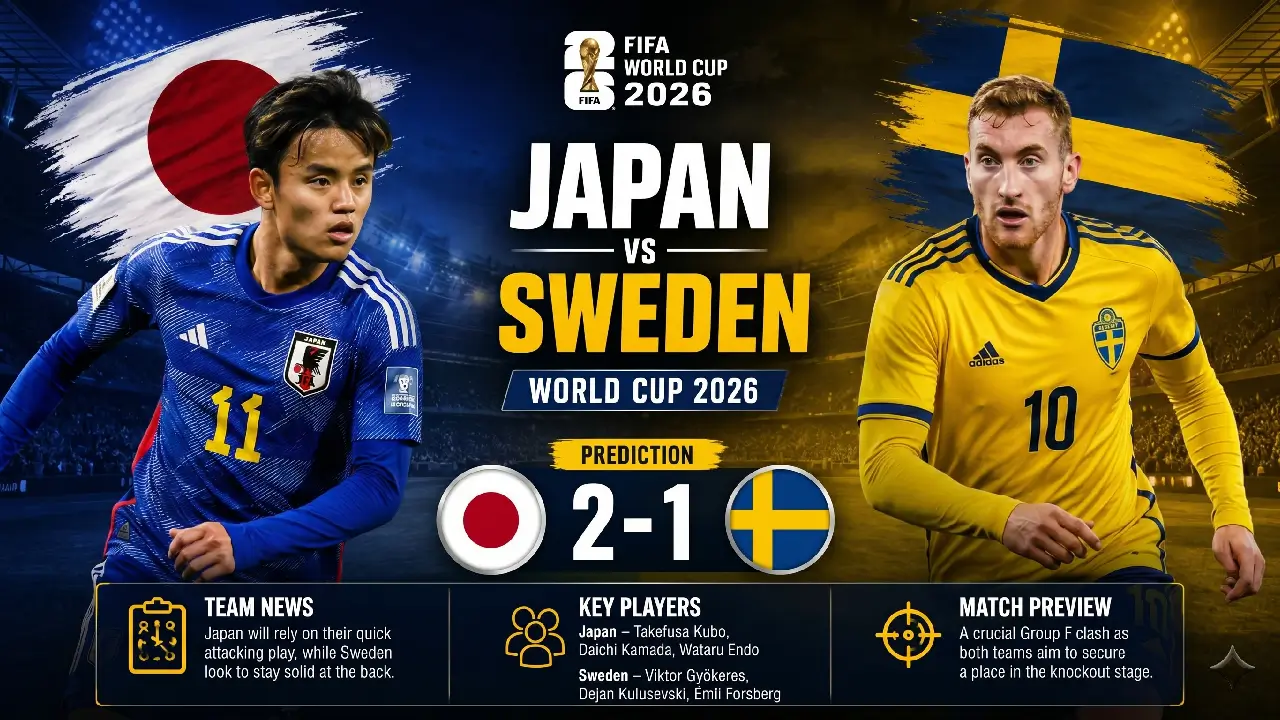
Expect Japan to control possession in long stretches, absorb Sweden’s transition moments, and find at least one moment of individual quality from Ueda or Kamada to settle the contest. A low-scoring Japan win, somewhere around 2-1, fits both the statistical profile and the tactical picture better than a Sweden upset built on hope rather than evidence.
Sweden’s defensive issues are the deciding variable. Until Potter solves them, predictions favoring his side require ignoring what already happened in Houston. Japan have the discipline, the depth, and the recent form to make this group’s final round of fixtures end exactly the way the numbers suggest it should.
What is the score prediction for Japan vs Sweden?
The most likely outcome favors Japan by a narrow margin, around 2-1, based on their defensive solidity and Sweden’s recent vulnerabilities against high-pressing opposition.
Does Japan need to win to qualify from Group F?
No. Japan only needs a draw against Sweden to guarantee a top-two finish in Group F, while a win secures first place outright.
Does Sweden need to win this match?
Yes. Sweden requires a win to avoid relying on the wildcard third-place rankings to progress to the knockout stage.
Who is Japan’s key player against Sweden?
Ayase Ueda has been Japan’s standout performer this tournament, with two goals and one assist giving him the joint-most goal involvements by a Japanese player in a single World Cup.
Who is Sweden’s main attacking threat?
Alexander Isak leads Sweden’s attack, having already set a new national record for goal involvements at a single World Cup since 1966, with support from striker Viktor Gyokeres.
Have Japan and Sweden ever met at a World Cup before?
No. This will be the first World Cup meeting between Japan and Sweden, despite the two nations having played five times previously, dating back to 1936.
What injuries are affecting Japan’s squad?
Japan are missing captain Wataru Endo for this fixture, and winger Takefusa Kubo is managing a knee injury sustained during the draw with the Netherlands.