

In This Article
In an era where T20 batting increasingly prioritizes bat speed, boundary percentage, and premeditated range-hitting, Babar Azam continues to operate through control of angles, balance at impact, and manipulation of field geometry. That distinction matters. Modern batting conversations often collapse technique into aesthetics, yet Babar’s output across formats has consistently originated from repeatable mechanics rather than improvisational chaos.
The deeper value of any serious Babar Azam batting technique analysis lies in understanding how he preserves shape under pressure. His game is not built around exaggerated trigger movements or explosive weight transfer. Instead, the structure remains compact enough to survive late swing, variable bounce, and tactical bowling plans targeting the corridor outside off stump.
That technical restraint defines his run-scoring architecture.
The Structural Base of Babar Azam’s Batting
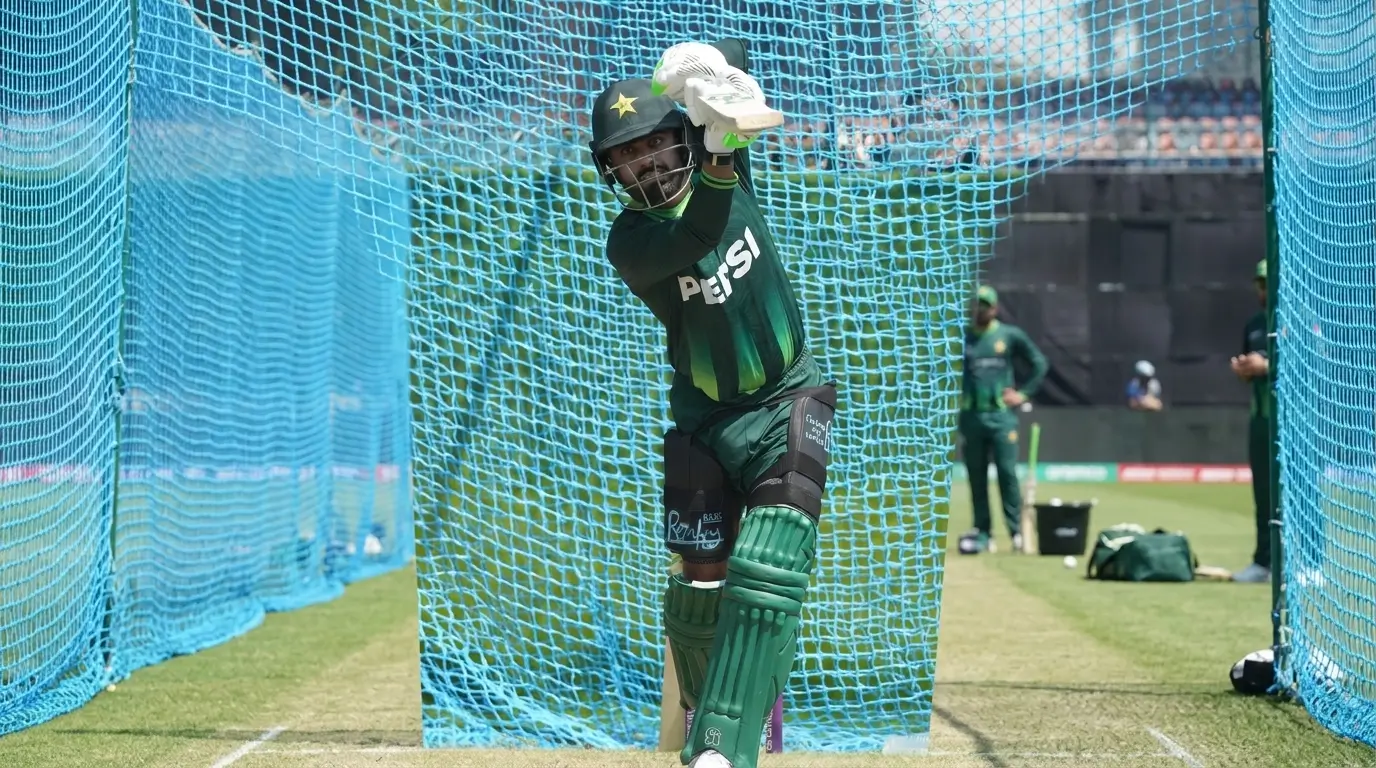
Every detailed Babar Azam batting technique analysis begins with his base position at the crease. His stance remains slightly open without exposing the front shoulder too early. The head stays remarkably still through release point. Minimal excess movement. No unnecessary bat flourish before impact.
That economy of motion changes everything.
Against fast bowling, Babar keeps his initial trigger small enough to preserve reaction time. His back foot shifts subtly across the stumps rather than planting aggressively toward leg side. This matters against bowlers targeting fourth stump because it prevents his front hip from collapsing too early across the line.
The result is balance through contact.y=mx+b
While batting mechanics cannot be reduced entirely to geometry, Babar’s alignment often resembles linear efficiency. Head position, front shoulder, and bat path remain connected through a direct channel toward extra cover or mid-off. The bat does not loop excessively behind the body. That shortens recovery time between defensive and attacking responses.
Many subcontinental batters struggle when pace bowlers attack the top of off stump with scrambled seam movement. Babar’s setup limits this vulnerability because his bat descends close to the pad line instead of swinging across it. Even when beaten, he rarely loses overall posture.
That technical detail repeatedly appears in elite-level Babar Azam batting technique analysis.
Why the Cover Drive Defines His Batting Identity
The cover drive remains the central visual signature in any Babar Azam batting technique analysis, but the shot itself is frequently misunderstood. It is not merely elegant timing. It is controlled sequencing.
The front foot moves toward the pitch of the ball without overstriding. His knee bends enough to stabilize body weight, while the head remains slightly ahead of contact point. Crucially, his hands stay inside the line until the final extension phase. That reduces the risk of hard outside edges against seam movement.
Tiny margins.
Many modern batters drive on the rise with dominant bottom-hand acceleration. Babar operates differently. His top hand controls the bat face deep into impact, allowing him to keep the ball grounded through the extra-cover channel even at high pace.
The wrists complete the shot late.
Against right-arm seamers angling across him, he delays commitment fractionally longer than most top-order players. This delay is difficult to identify in real time, yet it changes the probability of mistiming. Bowlers searching for outside-edge dismissals often end up feeding his strongest scoring zone because his balance permits adjustment after release rather than before it.
That distinction separates technically stable driving from aesthetic strokeplay.
Shot Selection Under Different Match Conditions
A proper Babar Azam batting technique analysis cannot isolate mechanics from decision-making. His scoring patterns change significantly depending on format, field restrictions, and surface behavior.
| Tactical Area | Technical Detail | Match Impact | Common Bowling Counter |
|---|---|---|---|
| Cover Drive Execution | Late hand release with dominant top-hand control | High off-side boundary efficiency | Fourth-stump seam movement |
| Trigger Movement | Minimal pre-delivery shuffle | Preserves reaction time against pace | Back-of-length hard seam |
| ODI Strike Rotation | Soft-hand deflections into square zones | Prevents middle-over stagnation | Tight infield ring pressure |
| Spin Footwork | Alternates crease depth with selective advances | Disrupts spinner length control | Wider lines outside off |
| Test Match Defense | Compact bat-pad connection | Reduces edge probability early innings | Full wobble-seam attack |
| T20 Tempo Construction | Boundary access through timing over brute force | Sustained innings stability | Pace-off variations into body |
In Test cricket, Babar narrows his scoring map early in the innings. The straight drive becomes more frequent. Horizontal-bat strokes reduce sharply before he reaches rhythm. He often avoids forcing square-of-the-wicket shots against fresh seam movement during the first thirty deliveries.
Patience first.
This approach occasionally attracts criticism in high-pressure run chases where scoring rates become compressed, but tactically it preserves innings longevity. His method values occupation of crease space before acceleration.
Middle-over accumulation defines much of Pakistan’s ODI structure, and Babar’s ability to manipulate soft hands into vacant midwicket or square-leg zones prevents stagnation without exposing high-risk aerial hitting too early. Similar pacing mechanics appear in elite chase specialists, particularly in this detailed analysis of Virat Kohli chase mastery.
Fielding restrictions during the powerplay create temporary gaps through backward point and cover region. Babar exploits these zones not through raw force but through timing against pace. He frequently opens the face late to third man when bowlers attempt hard-length lines. Once spin enters, his strike rotation becomes central to innings construction.
Singles matter here.
Middle-over accumulation defines much of Pakistan’s ODI structure, and Babar’s ability to manipulate soft hands into vacant midwicket or square-leg zones prevents stagnation without exposing high-risk aerial hitting too early.
T20 cricket creates the most scrutiny within any Babar Azam batting technique analysis because tempo expectations are harsher. Critics often compare him to ultra-aggressive openers whose intent begins immediately at ball one. Yet Babar’s T20 framework relies on maintaining shape while sustaining boundary access through gaps rather than continuous slogging.
His scoring tempo rises through sequencing, not chaos.
Footwork Against Pace and Spin
The most technically important section of any Babar Azam batting technique analysis involves his feet.
Against pace bowling, his first movement remains compact enough to react late. Many batters commit too early either forward or back, allowing bowlers to manipulate length after release. Babar preserves neutrality longer. That enables quick adjustment against wobble seam deliveries or cutters.
His back-foot game deserves more attention.
When bowlers shorten length outside off stump, he transfers weight deep into the crease rather than hopping upward. This keeps his head level and opens access to square boundaries without losing control over bat angle. Pull shots remain selective, but the punch through cover-point becomes highly productive because of this positioning.
Spin presents different demands.
Against finger spin, Babar frequently uses depth of crease instead of exaggerated dancing down the track. He moves late. That disrupts length judgment for spinners attempting to settle into defensive channels. On slower surfaces, he also closes the bat face slightly through midwicket when rotating strike, minimizing the risk of leading edges against grip.
Subtle adjustments dominate his game.
The Tactical Role Across Formats
Any meaningful Babar Azam batting technique analysis must examine role definition rather than isolated shot-making clips.
In Tests, Babar functions as Pakistan’s stabilizing top-order reference point. His role extends beyond scoring volume. He absorbs difficult overs against the new ball, particularly when seam conditions threaten batting collapses. This often suppresses his natural scoring tempo early in innings, but it protects the middle order from exposure against high-quality pace attacks.
Control over volatility.
ODI cricket demands dual responsibility. Babar frequently anchors innings while simultaneously maintaining enough strike rotation to prevent pressure accumulation. This balancing act becomes particularly important after early wickets when Pakistan’s middle order risks entering consolidation mode too early.
His pacing structure usually follows three phases:
Early preservation.
Middle-over accumulation.
Controlled acceleration after set position.
The transitions are deliberate rather than instinctive.
In T20s, however, tactical debates intensify because modern franchise cricket increasingly rewards explosive powerplay scoring. Babar’s strike rate discussions often ignore contextual factors such as surface difficulty, boundary dimensions, and wicket preservation responsibilities.
He rarely bats recklessly inside the first ten balls.
That restraint can appear conservative statistically, yet it also reduces collapse probability during difficult batting conditions where surfaces slow dramatically after the powerplay.
Technical Vulnerabilities Opponents Continue to Target
Even the strongest Babar Azam batting technique analysis must address recurring weaknesses.
Right-arm seamers attacking wide fourth-stump channels continue to create dismissal opportunities, especially when Babar attempts acceleration through off-side expansion. His desire to maintain scoring pressure occasionally pulls his hands slightly away from body alignment.
That creates edges.
On surfaces with steep bounce, bowlers targeting back-of-length deliveries near rib height can also restrict his preferred driving zones. Because his game relies heavily on shape preservation, hostile short-ball plans occasionally reduce scoring freedom rather than producing direct dismissals.
The issue is not fear of pace.
It is scoring restriction.
Leg-side boundary options also narrow temporarily when bowlers cramp him with cross-seam angles into the body. During these periods, his strike rotation becomes essential because clean release shots are less available.
Why Young Batters Study His Method Closely
The reason aspiring cricketers repeatedly search for Babar Azam batting technique analysis is simple: his batting remains reproducible.
Many modern T20 methods depend on extraordinary bat speed or physical power inaccessible to most developing players. Babar’s framework is different. It emphasizes repeatable positioning, late decision-making, and controlled weight transfer.
Young batters can train those elements.
His game demonstrates that timing remains structurally connected to balance. Players chasing instant power often lose head stability during impact, causing inconsistent contact points. Babar rarely loses alignment because his movements stay compact from release to follow-through.
That consistency survives pressure.
The cover drive attracts attention, but the deeper lesson comes from restraint. He does not attempt every scoring option every over. He constructs innings through selective expansion based on conditions, field placement, and bowler rhythm.
That remains increasingly rare in modern cricket.
Conclusion
A complete Babar Azam batting technique analysis reveals far more than elegant strokeplay. His batting survives through positional discipline, delayed commitment against seam movement, controlled top-hand dominance, and highly calculated shot selection across formats.
The cover drive represents only the visible layer.
Underneath sits a batting structure designed to reduce technical collapse under pressure. His footwork preserves reaction time. His head position stabilizes impact. His scoring progression changes according to format rather than personal aesthetic preference.
Those mechanics explain his consistency far more accurately than highlight compilations ever could.
Did Babar Azam build his batting around the cover drive?
Yes. The cover drive operates as his primary scoring release against pace bowling, particularly during early innings phases when fielders remain inside the ring and bowlers target traditional off-stump channels.
How does Babar Azam change his approach in T20 cricket?
He compresses risk rather than exploding intent immediately. His T20 method prioritizes shape retention, strike rotation, and boundary timing instead of constant aerial aggression from ball one.
What makes Babar Azam’s footwork effective against spin?
Late movement. He frequently shifts deep into the crease after release, forcing spinners to constantly reassess length instead of settling into repetitive defensive patterns.
Why do coaches use Babar Azam as a technical reference point?
His batting mechanics remain teachable. Young players can realistically replicate his alignment, footwork discipline, and shot sequencing without requiring elite physical strength.
Has modern T20 cricket exposed limitations in Babar Azam’s approach?
Partially. Ultra-aggressive powerplay scoring trends have increased scrutiny on his strike rate, particularly compared to openers who attack immediately regardless of wicket risk.