

In This Article
The countdown is no longer theoretical. Stadium crews are testing operations, national teams are navigating qualification pathways, and broadcasters are preparing for the largest football tournament ever staged. The FIFA World Cup 2026 will not simply crown a champion. It will redefine the scale of international football.
For the first time, the FIFA World Cup 2026 will feature 48 national teams instead of 32. That single change alters everything—from qualification routes and group-stage dynamics to travel logistics and tournament scheduling. Fans accustomed to the traditional format will encounter a competition that is bigger, longer, and strategically more demanding.
With three host nations, dozens of host cities, and more matches than any previous edition, the FIFA World Cup 2026 represents one of the most ambitious sporting events ever organized.
What Is the FIFA World Cup 2026?
The FIFA World Cup 2026 is the 23rd edition of football’s premier international tournament. Organized by FIFA, the competition will be jointly hosted by the United States, Canada, and Mexico.
This marks the first time three countries will share hosting responsibilities for a men’s World Cup.
Mexico will become the first nation to host World Cup matches in three separate tournaments. The United States returns as a host after the commercially transformative 1994 edition, while Canada hosts men’s World Cup matches for the first time.
The FIFA World Cup 2026 is expected to attract billions of viewers worldwide, making it one of the most watched sporting events in history.
FIFA World Cup 2026 Host Countries
The FIFA World Cup 2026 will be staged across North America.
The host nations are:
- United States
- Canada
- Mexico
The majority of matches will be played in the United States, while Canada and Mexico will each host selected group-stage and knockout fixtures.
The three-country model presents unique logistical challenges. Teams could travel thousands of kilometers during the tournament, making squad rotation, recovery planning, and sports science support more important than ever.
FIFA World Cup 2026 Format Explained
The biggest story surrounding the FIFA World Cup 2026 is the expansion to 48 teams.
Previous editions featured 32 nations. The new structure significantly increases participation opportunities for every confederation.
How Many Teams Will Play in the FIFA World Cup 2026?
A total of 48 teams will compete.
The expansion creates 16 additional places compared to recent World Cups and gives emerging football nations a more realistic path to qualification.
How Does the New Tournament Structure Work?
The FIFA World Cup 2026 format includes:
| Detail | Information |
|---|---|
| Teams | 48 |
| Groups | 12 |
| Teams Per Group | 4 |
| Total Matches | 104 |
| Host Countries | USA, Canada, Mexico |
| Group Stage Matches | 72 |
| Round of 32 Teams | 32 |
| Final Date | 19 July 2026 |
| Opening Match Date | 11 June 2026 |
This structure increases the total number of matches to 104.
That is a substantial jump from the 64 matches played in recent World Cups.
The additional knockout round creates new strategic considerations. Teams that previously needed to survive three group matches and four knockout matches must now potentially navigate five elimination games after the group stage.
FIFA World Cup 2026 Groups
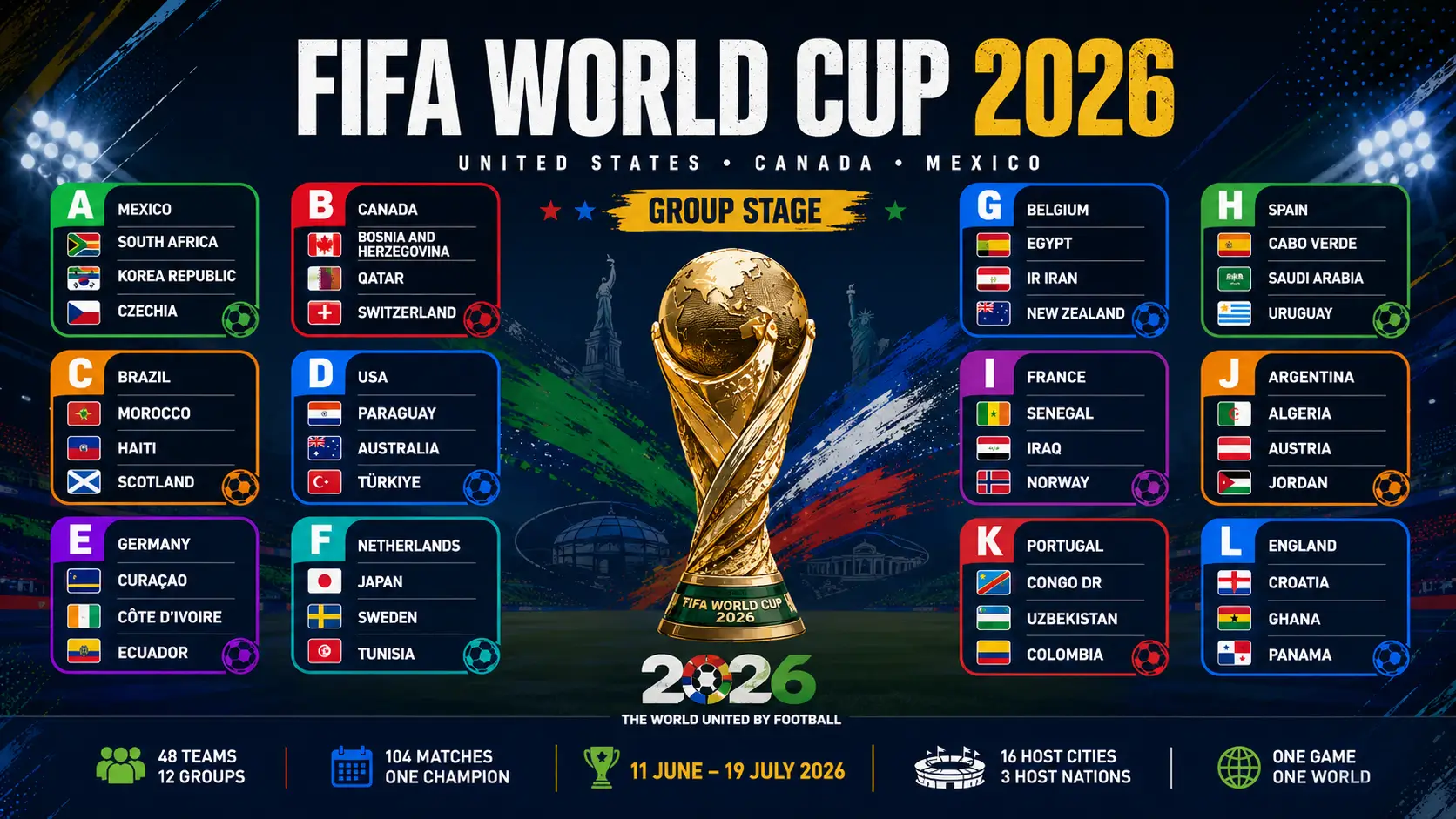
The official FIFA World Cup 2026 groups will be finalized after qualification concludes and the final tournament draw takes place.
Twelve groups will be created, traditionally labeled Group A through Group L.
Each group will contain four teams.
The expanded format changes the mathematics of qualification. Third-place finishes become far more valuable because eight third-placed teams will still advance to the knockout rounds.
That means goal difference, disciplinary records, and late-match decision-making could carry even greater importance than in previous tournaments.
How Will Teams Be Seeded?
FIFA rankings are expected to play a major role in the seeding process.
Higher-ranked nations will be distributed across different groups to reduce the likelihood of major contenders meeting during the opening stage.
This approach aims to maintain competitive balance while preserving global representation.
FIFA World Cup 2026 Qualified Teams
The final list of FIFA World Cup 2026 teams will be confirmed once qualification campaigns conclude across all confederations.
Several traditional powers are widely expected to participate, including:
- Brazil
- Argentina
- France
- Germany
- England
- Spain
- Portugal
- Netherlands
The expanded FIFA World Cup 2026 field also increases opportunities for nations from Africa, Asia, Oceania, and the CONCACAF region.
As a result, fans are likely to see several debutants alongside established football powers.
FIFA World Cup 2026 Schedule
The FIFA World Cup 2026 schedule spans more than five weeks.
The tournament begins in June 2026 and concludes with the final in July 2026.
The schedule includes:
Group Stage
The opening phase features 72 matches across 12 groups.
Teams play three group matches each.
Every point becomes crucial because both direct qualification spots and third-place rankings influence progression.
Round of 32
The FIFA World Cup 2026 introduces a new knockout round.
Thirty-two teams advance from the group stage, creating an additional elimination phase before the traditional Round of 16.
Round of 16
The surviving teams enter a more familiar bracket structure.
At this stage, tactical flexibility often becomes the difference between advancement and elimination.
Quarterfinals
Only eight teams remain.
Historically, this phase separates talented squads from genuinely championship-caliber teams.
Semifinals
The margin for error shrinks dramatically.
A single defensive lapse, set-piece mistake, or missed chance can define an entire tournament.
Final
The FIFA World Cup 2026 culminates with the championship match, where one nation lifts football’s most prestigious trophy.
Why the FIFA World Cup 2026 Is Different
Expansion alone does not tell the full story.
The FIFA World Cup 2026 combines three major changes:
- More teams
- More matches
- More host cities
That combination increases competitive diversity while also creating unprecedented organizational complexity.
Coaches will manage deeper squads. Analysts will process larger volumes of opponent data. Medical staffs will face heavier workloads due to travel demands.
Small details may become decisive.
A recovery session delayed by travel. A squad rotation decision in the second group match. A suspension picked up late in the opening round.
These factors often determine who survives a long tournament.
What the Expanded Format Means for Smaller Nations
The FIFA World Cup 2026 offers opportunities that previously did not exist.
Many countries historically struggled to qualify because continental allocation limits left little margin for error.
The expanded tournament changes that equation.
African federations receive additional places. Asian nations benefit from increased access. Oceania gains a stronger pathway than ever before.
The result is a World Cup that more accurately reflects football’s global growth.
For supporters in emerging football markets, the FIFA World Cup 2026 could become a landmark moment in national sporting history.
Could the FIFA World Cup 2026 Produce More Upsets?
History suggests it might.
Tournament football rewards organization, discipline, and adaptability.
The expanded FIFA World Cup 2026 field increases the number of teams capable of causing surprises during the group stage and knockout rounds.
A well-structured defensive side can remain difficult to break down across a single match. Add the pressure of a global tournament, and favorites become vulnerable.
That unpredictability is part of the event’s enduring appeal.
Verdict
The FIFA World Cup 2026 is more than another edition of football’s greatest tournament. It is a structural transformation of the competition itself.
Forty-eight teams. Twelve groups. One hundred and four matches. Three host nations.
The scale is unprecedented.
Whether the expanded format improves competitive quality will remain a subject of debate until the final whistle. What is certain is that the FIFA World Cup 2026 will deliver more teams, more stories, more tactical variety, and more opportunities for football nations across the globe.
For fans, analysts, and players alike, it promises to be one of the most significant World Cups ever staged.
When does the FIFA World Cup 2026 start?
The FIFA World Cup 2026 begins in June 2026 and concludes in July 2026. Exact match schedules are determined by FIFA and the host cities.
How many teams will play in the FIFA World Cup 2026?
The FIFA World Cup 2026 will feature 48 national teams, making it the largest men’s World Cup in history.
How many groups are in the FIFA World Cup 2026?
There will be 12 groups consisting of four teams each. The top two teams plus the eight best third-placed teams advance.
Why was the FIFA World Cup expanded to 48 teams?
FIFA expanded the tournament to increase global representation and provide more qualification opportunities for nations across all confederations.
Which countries are hosting the FIFA World Cup 2026?
The tournament will be hosted by the United States, Canada, and Mexico, marking the first three-country World Cup.
How many matches will be played in the FIFA World Cup 2026?
A total of 104 matches will be played, significantly more than the 64-match format used in recent editions.
What is the new Round of 32 in the FIFA World Cup 2026?
The Round of 32 is an additional knockout stage introduced because of the expanded 48-team format. It creates an extra elimination round before the Round of 16.