

In This Article
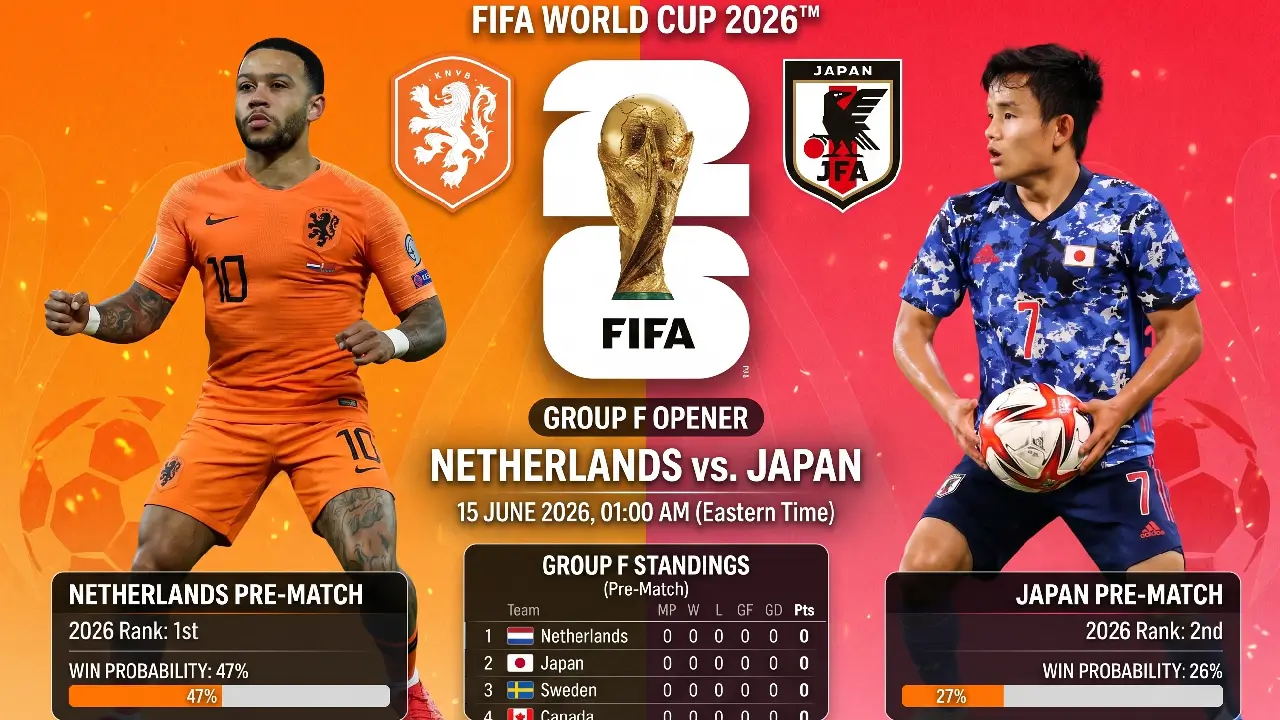
The tunnel lights dim. Players exchange quick glances. A European powerhouse with decades of tournament pedigree stands across from an Asian giant that has quietly become one of the most tactically disciplined teams in international football. That contrast is what makes Netherlands vs Japan FIFA World Cup 2026 one of the most intriguing matchups of the tournament.
This fixture is more than a clash of continents. It is a collision between contrasting football philosophies: Dutch positional play against Japanese collective precision. The margins are tiny. One pressing trigger. One transition. One tactical adjustment.
The stakes are enormous.
Why Netherlands vs Japan FIFA World Cup 2026 Matters
The Netherlands vs Japan FIFA World Cup 2026 encounter represents a modern football debate. Is elite tournament success driven by individual brilliance or by collective organization?
The Netherlands arrive with a long history of innovation. Their influence on tactical football stretches from Total Football to modern positional systems. Japan, meanwhile, has evolved into one of the most structured national teams in world football, regularly challenging elite opponents through tactical intelligence rather than star power alone.
That is why Netherlands vs Japan FIFA World Cup 2026 has drawn significant global attention.
A single match can reshape tournament narratives.
Historical Context: Netherlands and Japan on the World Stage
The Netherlands have repeatedly been among football’s strongest tournament performers without lifting the FIFA World Cup trophy. Finals in 1974, 1978, and 2010 underline their consistency.
Japan’s rise has been more recent but equally impressive. Since their first FIFA World Cup appearance in 1998, Japan have developed into Asia’s benchmark program, reaching multiple knockout stages and producing players for Europe’s top leagues.
The historical backdrop adds another layer to Netherlands vs Japan FIFA World Cup 2026.
One nation seeks long-awaited glory. The other seeks another breakthrough.
Netherlands Team Analysis
The Dutch approach remains rooted in ball progression, spatial control, and tactical flexibility.
Recent Dutch squads have often alternated between a back three and a back four. This flexibility allows them to adapt based on opposition pressing structures.
Defensive Structure
The Netherlands typically build from deep through technically gifted defenders. Their center-backs are comfortable carrying the ball forward, creating numerical superiority during buildup phases.
This becomes especially important in Netherlands vs Japan FIFA World Cup 2026, where Japan’s pressing system can disrupt traditional buildup patterns.
Midfield Control
Dutch midfielders excel in positional rotation. Instead of occupying fixed zones, they frequently exchange spaces to create passing angles and manipulate defensive lines.
The effectiveness of these rotations often determines whether the Netherlands can dominate possession during Netherlands vs Japan FIFA World Cup 2026.
Attacking Threat
The Dutch attack combines width with vertical penetration.
Wide forwards frequently drift inward, allowing overlapping full-backs to create overloads. This movement stretches compact defensive systems.
Japan are among the world’s best at defending compactly. Breaking that shape will be a defining challenge in Netherlands vs Japan FIFA World Cup 2026.
Japan Team Analysis
Japan’s rise has not been accidental.
It is the product of decades of investment in youth development, tactical education, and technical refinement.
The result is a team capable of competing with the world’s elite.
Tactical Discipline
Japan operate with remarkable collective organization. Defensive transitions are particularly impressive, with players often recovering shape within seconds of losing possession.
This discipline could prove decisive in Netherlands vs Japan FIFA World Cup 2026.
Pressing Efficiency
Japan’s pressing is not random.
Triggers are carefully coordinated. A backward pass or poor first touch often initiates immediate pressure. The synchronization allows Japan to recover possession without overcommitting.
Against Dutch buildup structures, this pressing may become one of the key tactical battles in Netherlands vs Japan FIFA World Cup 2026.
Rapid Transitions
Japan excel when attacking space.
Once possession is regained, their vertical transitions are swift and precise. Midfield runners frequently attack channels before defensive blocks can recover.
The Netherlands must remain compact to avoid exposure during Netherlands vs Japan FIFA World Cup 2026.
Key Players to Watch
Individual moments often decide World Cup matches.
This fixture is no exception.
Virgil van Dijk
The Dutch captain remains one of football’s elite defenders. His aerial dominance, anticipation, and passing range make him central to Dutch stability.
His ability to neutralize Japanese transitions could shape Netherlands vs Japan FIFA World Cup 2026.
Frenkie de Jong
Few midfielders manipulate space like De Jong.
His press resistance allows the Netherlands to escape pressure. By turning under pressure and accelerating into open space, he can break defensive structures with minimal touches.
That skill may prove invaluable during Netherlands vs Japan FIFA World Cup 2026.
Takefusa Kubo
Japan’s creative spark offers unpredictability in attacking areas. His close control and rapid directional changes create separation even in congested zones.
In matches like Netherlands vs Japan FIFA World Cup 2026, moments of creativity can determine outcomes.
Kaoru Mitoma
Mitoma’s dribbling mechanics are exceptional. His low center of gravity allows rapid acceleration during one-versus-one situations, often creating advantages within fractions of a second.
The Dutch defense will need to contain him throughout Netherlands vs Japan FIFA World Cup 2026.
Tactical Battle: Possession vs Precision
At its core, Netherlands vs Japan FIFA World Cup 2026 is a tactical contest.
The Netherlands prefer sustained possession. Japan prioritize efficient transitions.
The Dutch seek control.
Japan seek disruption.
Whichever team imposes its preferred rhythm gains a significant advantage.
If the Netherlands dominate territory, Japan may struggle to launch counterattacks. Yet if Japan force turnovers in midfield, Dutch defenders could face dangerous transitional situations.
This tactical contrast is what makes Netherlands vs Japan FIFA World Cup 2026 so compelling.
What Could Decide the Match?
Small details matter.
Very small details.
A misplaced pass under pressure. A delayed defensive rotation. A momentary lapse in concentration.
World Cup matches often swing on such margins.
Set Pieces
The Netherlands traditionally hold an aerial advantage. Corners and free kicks could become decisive in Netherlands vs Japan FIFA World Cup 2026.
Transition Defense
Japan thrive in transition moments. The Dutch midfield must provide immediate defensive coverage after losing possession.
Tempo Control
The team controlling tempo frequently controls outcomes. Slowing the game or accelerating transitions at the right moments may determine Netherlands vs Japan FIFA World Cup 2026.
What Is the Biggest Strength of the Netherlands?
Dutch Tactical Flexibility
One of the Netherlands’ greatest strengths is adaptability.
They can switch formations during matches without disrupting structure. This tactical flexibility allows them to respond effectively to different opponents and match situations.
That versatility may become crucial in Netherlands vs Japan FIFA World Cup 2026.
What Is Japan’s Greatest Advantage?
Collective Organization
Japan’s greatest strength lies in collective discipline.
Every player understands positional responsibilities. Defensive recovery patterns are highly coordinated, making them difficult to break down.
This organization could frustrate Dutch attacking patterns in Netherlands vs Japan FIFA World Cup 2026.
How Could the Match Unfold?
The early stages may be cautious.
The Netherlands are likely to dominate possession while Japan remain compact and patient. As the match progresses, spaces may emerge, particularly during transitional moments.
A single tactical adjustment could shift momentum dramatically.
That unpredictability is precisely why Netherlands vs Japan FIFA World Cup 2026 stands out as one of the tournament’s most fascinating fixtures.
Verdict
Predicting Netherlands vs Japan FIFA World Cup 2026 is difficult because both teams possess distinct strengths.
The Netherlands bring tournament pedigree, technical quality, and tactical versatility.
Japan offer organization, pressing intensity, and transition efficiency.
On paper, the Dutch may enter as favorites. Football, however, rarely follows paper.
World Cups reward preparation.
They reward adaptability.
Most of all, they reward teams that seize moments.
When the whistle blows, history means little. Execution means everything.
Who is favored in Netherlands vs Japan FIFA World Cup 2026?
The Netherlands are generally considered favorites due to their tournament history and squad depth. Japan, however, have repeatedly upset stronger teams in recent World Cups.
Why is Netherlands vs Japan FIFA World Cup 2026 tactically interesting?
The match features contrasting styles: Dutch possession football versus Japan’s organized pressing and rapid transitions.
Which players could decide Netherlands vs Japan FIFA World Cup 2026?
Players such as Virgil van Dijk, Frenkie de Jong, Takefusa Kubo, and Kaoru Mitoma could significantly influence the match.
What is Japan’s biggest strength heading into the match?
Japan’s collective organization and defensive discipline are among the strongest in international football.
How do the Netherlands usually approach big matches?
The Dutch typically emphasize possession, positional play, and tactical flexibility to control games.
Could set pieces play a major role?
Yes. The Netherlands often possess an aerial advantage, making corners and free kicks potentially decisive.
Why is this match important in FIFA World Cup 2026?
The fixture showcases two highly developed football systems and could have major implications for group-stage qualification or knockout progression.