

In This Article
Understanding Association Football Rules Beyond the Basics
Association Football Rules Explained is more than a discussion of technical regulations. The laws shape every tactical decision, every defensive structure, every pressing trigger, and every attacking movement seen across modern football. While spectators often focus on goals, substitutions, and controversial decisions, the sport itself is governed by a detailed framework designed to balance competition, player safety, and match continuity.
The modern game operates under a universal set of standards recognized across domestic leagues, continental competitions, youth academies, and international tournaments. Whether a match takes place in a local amateur division or during the FIFA World Cup, the same foundational principles apply. This consistency allows players, coaches, officials, and supporters to interpret the game through a shared understanding.
Association Football Rules Explained requires more than memorizing fouls and restarts. It demands an understanding of why the laws exist, how referees apply them, and how teams adapt their tactics around those regulations.
Football is controlled chaos.
The laws create the boundaries within which that chaos remains competitive rather than disorderly.
The Framework Behind Modern Football
The global authority responsible for maintaining football’s laws is the International Football Association Board (IFAB). FIFA adopts these laws for worldwide competition, ensuring that the game follows a standardized rulebook regardless of geography. A detailed reference of the official Laws of the Game can be found in the complete documentation on Wikipedia.
This structure has profound tactical implications.
A center-back defending a counterattack in England faces the same disciplinary framework as a defender in Brazil. A goalkeeper managing possession in Germany operates under identical handling restrictions as one competing in Japan. Uniformity matters because football’s tactical ecosystem depends on predictable interpretation.
Association Football Rules Explained becomes especially relevant when examining elite-level competition, where margins between victory and defeat are often measured in a single decision involving an offside call, handball judgment, or penalty award.
At the professional level, every law influences behavior.
Managers spend significant portions of training sessions preparing players for scenarios directly affected by the rulebook.
Match Duration and Time Management
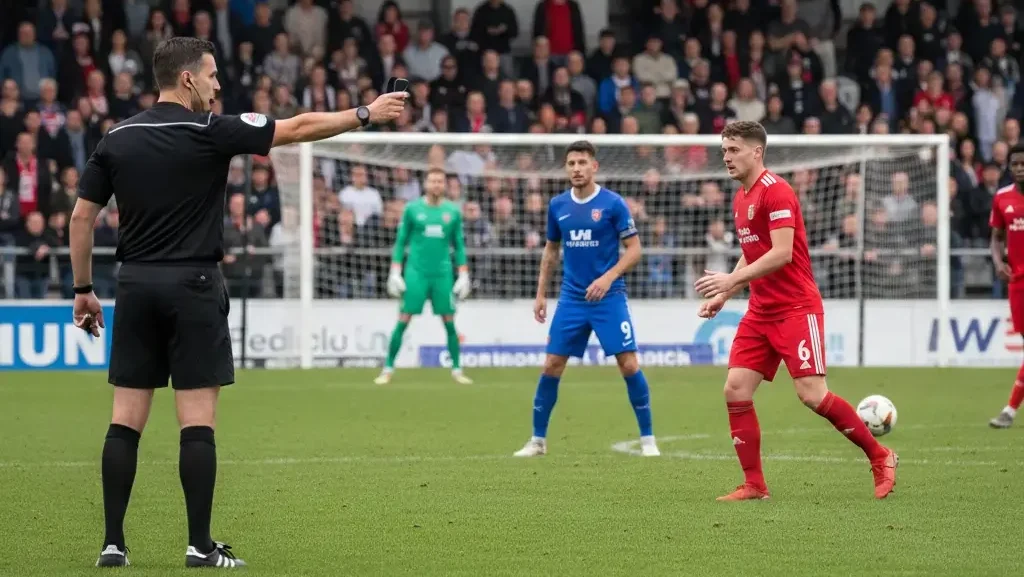
A standard football match consists of two 45-minute halves separated by halftime. However, the actual playing time frequently differs from the displayed clock due to injuries, substitutions, disciplinary actions, celebrations, and various stoppages.
This is where added time becomes strategically significant.
Teams protecting a narrow lead often attempt to reduce match tempo through controlled possession sequences, while trailing sides seek rapid restarts and increased ball circulation. Referees account for lost time by adding minutes at the end of each half.
The introduction of more accurate stoppage-time calculations has altered match dynamics considerably.
Late-game tactical management now carries greater risk because teams can no longer assume that traditional time-wasting methods will significantly reduce active playing time.
Association Football Rules Explained cannot ignore this development because match duration directly impacts tactical decision-making.
The clock matters.
But how the clock is managed matters even more.
Player Roles and Positional Responsibilities
Each team fields eleven players, including one goalkeeper and ten outfield players. While tactical systems may vary dramatically—from aggressive high-pressing structures to deep defensive blocks—the laws establish identical player eligibility requirements.Understanding how goalkeepers, defenders, midfielders, and forwards operate within these legal frameworks becomes much easier when studying our detailed guide on Football Positions and Player Roles Explained for Beginners and Coaches.
The goalkeeper occupies a unique legal position.
Inside the penalty area, the goalkeeper may handle the ball. Outside that zone, the goalkeeper becomes subject to the same restrictions as every other player on the field.
This distinction influences modern tactical systems.
Many elite clubs use goalkeepers as additional passing options during build-up phases. Their positioning often extends well beyond traditional goalkeeping territory, creating numerical advantages against opposition presses.
Yet the legal framework remains clear.
Once outside the penalty area, the goalkeeper loses handling privileges entirely.
Association Football Rules Explained highlights how a seemingly simple rule can transform broader tactical structures throughout the game.
Fouls: The Foundation of Match Discipline
Fouls represent one of the most influential areas within football’s regulatory framework because they govern player interaction during contested moments.
The laws categorize offenses according to the nature and severity of the action.
A careless challenge may result in a free kick without disciplinary sanctions. A reckless challenge introduces yellow-card territory. Excessive force elevates the offense into potential red-card territory.
Context matters.
The same physical contact can produce different outcomes depending on speed, intensity, point of contact, and player safety considerations.
Association Football Rules Explained often becomes most important when evaluating subjective decisions. Referees must assess whether a tackle endangered an opponent, whether a push disrupted balance unfairly, or whether a challenge exceeded acceptable competitive contact.
Football remains a physical sport.
Not every collision is a foul.
That distinction separates legal aggression from punishable conduct.
Handling Offenses and Modern Interpretation
Few areas generate more debate than handball interpretation.
Contrary to popular belief, ball-to-hand contact does not automatically constitute an offense. Officials assess factors including arm position, body movement, reaction time, and whether the player’s actions created an unnatural barrier.
The analysis is nuanced.
Defenders frequently adjust body posture while challenging opponents, blocking shots, or changing direction. Referees must determine whether arm positioning exceeded what would be reasonably expected during that movement.
Association Football Rules Explained requires understanding intent alongside physical mechanics.
The law evaluates actions.
Not assumptions.
Yellow Cards, Red Cards, and Game Control
Disciplinary sanctions serve as behavioral management tools rather than purely punitive measures.
A yellow card functions as a formal caution. It communicates that a player’s conduct has crossed an acceptable threshold without necessarily warranting removal from the match.
Accumulating two cautions results in dismissal.
A direct red card, meanwhile, addresses more severe offenses. Serious foul play, violent conduct, offensive language, and denial of an obvious goal-scoring opportunity frequently trigger immediate expulsion.
The tactical consequences are substantial.
Competing with ten players often forces structural changes involving deeper defensive positioning, reduced pressing intensity, and altered attacking priorities.
Numerical disadvantages reshape matches quickly.
Elite teams prepare extensively for these scenarios.
Association Football Rules Explained demonstrates that disciplinary decisions influence tactical outcomes just as much as technical skill.
Restarts and Their Tactical Importance
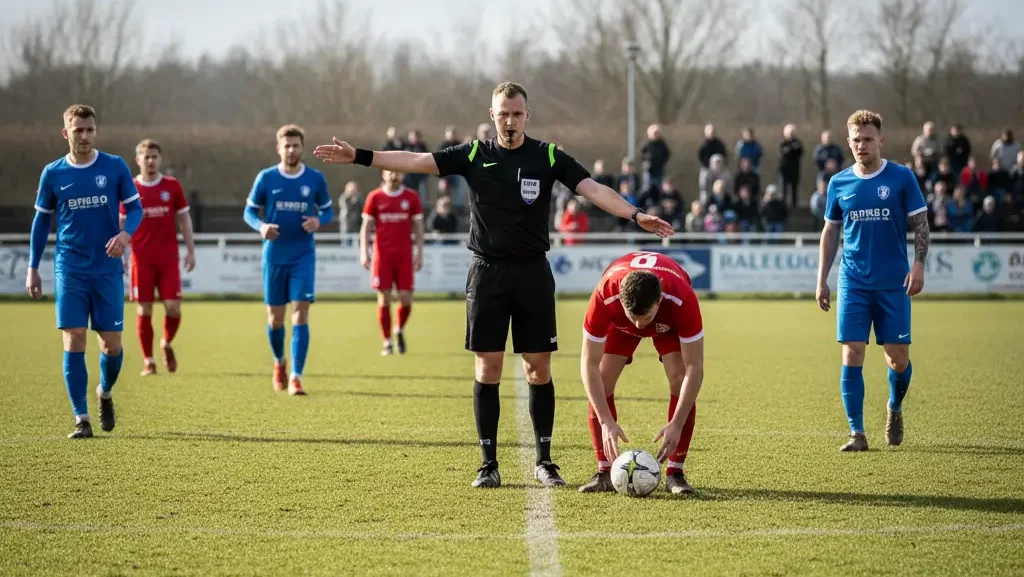
Many supporters view restarts as administrative procedures.
| Match Situation | Governing Law | Tactical Impact | Referee Priority |
|---|---|---|---|
| Direct Free Kick | Law 13 | Immediate scoring threat or territory gain | Proper distance and restart legality |
| Indirect Free Kick | Law 13 | Structured attacking pattern required | Second touch validation |
| Penalty Kick | Law 14 | Highest-probability scoring event | Encroachment and goalkeeper position |
| Corner Kick | Law 17 | Set-piece chance with high xG potential | Ball placement and restart timing |
| Goal Kick | Law 16 | Press resistance and build-up initiation | Correct restart procedure |
| Throw-In | Law 15 | Quick transition opportunity | Proper throw technique |
| Offside Decision | Law 11 | Controls attacking space exploitation | Active involvement assessment |
| Disciplinary Sanction | Law 12 | Alters numerical balance and tactics | Match control and player safety |
They are far more significant than that.
Every restart represents a controlled opportunity to establish field position, create attacking pressure, or regain defensive organization.
Free Kicks
Free kicks emerge from fouls and technical infringements. They exist in two forms.
Direct free kicks allow immediate scoring attempts.
Indirect free kicks require an additional touch before a goal can count.
Location dramatically affects strategic value.
A direct free kick thirty yards from goal presents a scoring opportunity. An identical restart near midfield may function primarily as a platform for territorial advancement.
Teams invest countless training hours developing specialized routines around these situations.
Dead-ball phases generate meaningful expected-goals output across elite football.
Penalty Kicks
The penalty kick remains football’s highest-probability scoring situation.
Awarded for qualifying defensive fouls inside the penalty area, penalties seek to restore an attacking opportunity unfairly denied by illegal conduct.
The confrontation appears simple.
It rarely is.
Goalkeepers analyze shooting tendencies. Penalty takers study goalkeeper movement patterns. Psychological pressure intersects with technical execution in a highly compressed moment.
Association Football Rules Explained highlights penalties as both legal mechanisms and tactical events carrying disproportionate influence on match outcomes.
Throw-Ins, Goal Kicks, and Corner Kicks
Minor restarts frequently produce major consequences.
A poorly defended corner can concede a goal. A quick throw-in can expose an unsettled defensive structure. A strategically designed goal-kick pattern can bypass an aggressive press entirely.
Modern coaching staffs devote substantial analytical resources to restart optimization.
Margins are small.
The rewards are significant.
Offside: Football’s Most Misunderstood Law
No aspect of Association Football Rules Explained generates more confusion than the offside law.
The principle itself remains straightforward.
Players cannot gain unfair positional advantages by remaining near the opponent’s goal awaiting service.
The practical application becomes more complex.
A player may occupy an offside position without committing an offense. The violation occurs only when that player becomes actively involved in play through interference, participation, or advantage gained from the position.
Timing is critical.
Officials judge positioning at the precise moment the ball is played—not when it is received.
Modern technology has increased decision accuracy while simultaneously exposing the microscopic margins separating legal and illegal positioning.
Millimeters matter.
Elite attackers constantly adjust movement patterns to exploit defensive lines without crossing legal boundaries.
Association Football Rules Explained cannot be complete without recognizing offside as both a regulatory mechanism and a tactical battleground.
Why the Laws Continue to Evolve
Football’s laws are not static.
The game changes. Athlete profiles change. Tactical approaches change. Technological capabilities change.
Rule adjustments frequently emerge from practical challenges observed across professional competition.
Goal-line technology addressed scoring uncertainty. Video Assistant Referee systems sought greater decision accuracy. Updated handball interpretations attempted to clarify increasingly complex situations.
Each modification seeks balance.
Too much intervention disrupts flow. Too little intervention reduces fairness.
Association Football Rules Explained reveals a continuous process of refinement rather than radical transformation.
The objective remains consistent.
Protect competition integrity.
Preserve the sport’s identity.
Conclusion
Association Football Rules Explained is ultimately an examination of how football maintains competitive order without sacrificing fluidity. The laws govern everything from disciplinary sanctions and player eligibility to restarts, match duration, and offside decisions. Yet their true importance extends beyond enforcement.
Every tactical system operates within these boundaries.
Every referee decision emerges from them.
Every player adapts behavior because of them.
Understanding football’s laws provides a deeper view of the game itself—not merely what happens on the field, but why it happens. The regulations are not separate from football’s tactical landscape. They are embedded within every movement, challenge, transition, and restart that shapes the modern match.
What is the purpose of the offside rule in football?
To prevent unfair attacking positioning. The law stops attackers from permanently occupying advanced goal-hanging positions and forces teams to create scoring chances through coordinated movement and timing.
Can a player be offside without committing an offense?
Yes. Merely standing in an offside position is legal. The offense occurs only when the player becomes involved in active play, interferes with an opponent, or gains an advantage.
Why are some handball incidents not given as fouls?
Because contact alone is insufficient. Officials evaluate arm position, body movement, reaction time, and whether the player created an unnatural barrier that affected play.
What is the difference between careless and reckless tackles?
Reckless tackles carry greater disciplinary risk. A careless challenge usually results only in a free kick, while a reckless challenge often produces a yellow card because it disregards opponent safety.
Why do referees add stoppage time?
To recover lost playing time. Injuries, substitutions, disciplinary actions, goal celebrations, and delays reduce active play and must be compensated for under the laws.
How do modern football laws balance fairness and game flow?
Through referee discretion. Officials apply the laws while considering context, player safety, competitive equity, and the need to maintain continuous play whenever possible.