

In This Article
The Long Wait Ends for Peshawar ZalmiThe contrast was stark
Long championship droughts have become a recurring theme in franchise cricket. A similar story unfolded in the IPL when Royal Challengers Bengaluru finally captured their maiden title after years of near misses. Read our detailed analysis of RCB IPL 2026 Title: How Royal Challengers Bengaluru Finally Reached the Summit.
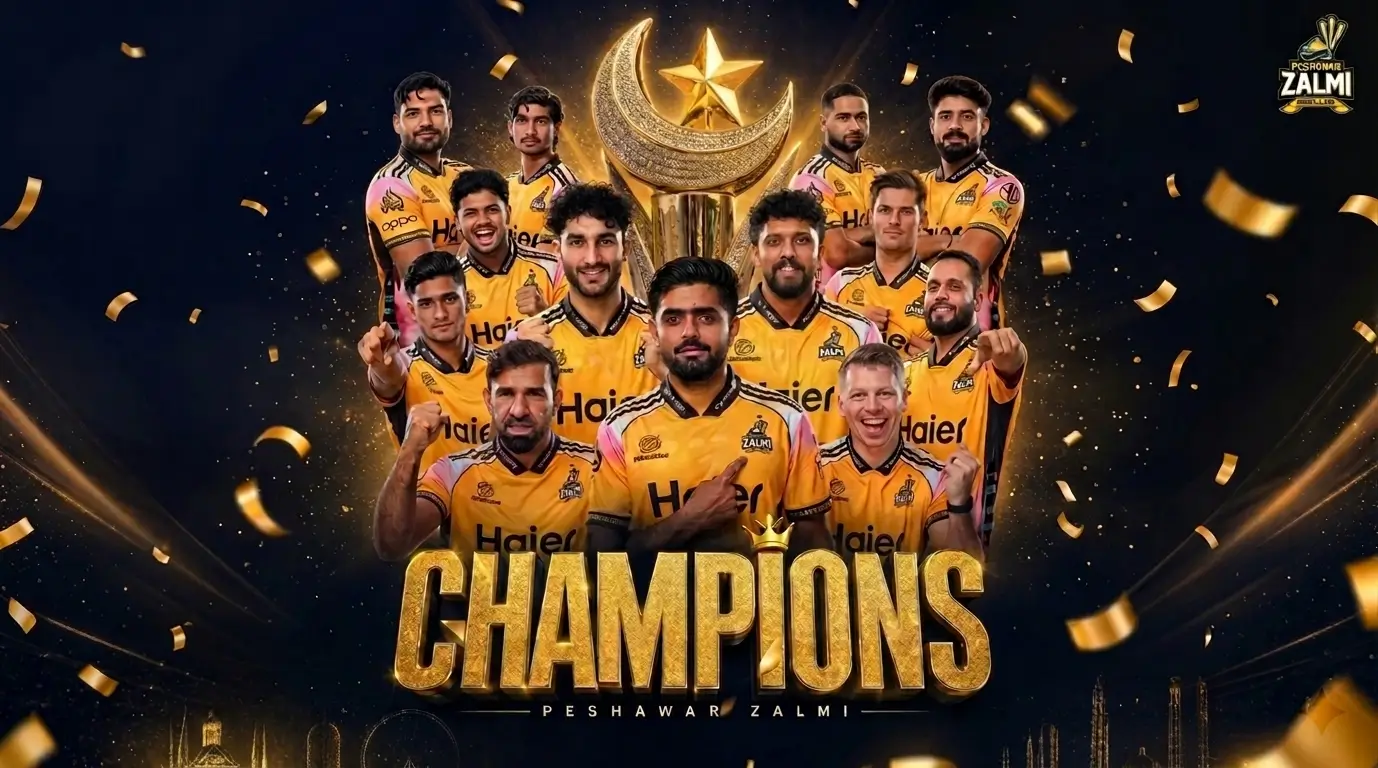
Peshawar Zalmi PSL 11 Champions is more than a title-winning headline. It marks the conclusion of a nine-year gap between trophies, a period filled with playoff disappointments, squad transitions, and a dramatic collapse in 2025 when the franchise failed to reach the knockout stage.
Few teams entered PSL 2026 carrying greater pressure.
The contrast was stark.
One season earlier, Peshawar Zalmi looked disconnected. Their batting lacked consistency, their bowling attack struggled to control middle overs, and their captain, Babar Azam, endured the least productive PSL campaign of his career. Twelve months later, the same franchise finished atop the table, dominated the playoffs, and lifted the trophy at a packed Gaddafi Stadium.
That transformation did not happen through emotion or momentum alone.
It was built on measurable improvements.
The Peshawar Zalmi PSL 11 Champions campaign was driven by tactical clarity, improved matchups against spin, a balanced middle order, and a bowling attack capable of restricting opponents without relying on extraordinary individual performances.
The final against Hyderabad Kingsmen merely confirmed what the league stage had already established.
Zalmi were the strongest side in the competition.
A Final Controlled by Bowling Pressure
The scoreboard recorded Hyderabad Kingsmen at 129 all out in 18 overs.
The collapse tells a deeper story.
After reaching 69/2, Kingsmen appeared positioned for a total approaching 160. Instead, Zalmi squeezed the middle phase with relentless discipline. Lengths became tighter. Singles disappeared. Boundary opportunities narrowed.
Aaron Hardie’s figures of 4/27 were central to that shift.
His spell did not rely on extravagant movement. He repeatedly attacked channels that forced batters into uncertain decisions. Hyderabad’s batters struggled to create scoring angles, particularly once the field spread after the powerplay.
Momentum vanished quickly.
The slide from 71/2 to 90/7 effectively decided the match.
Saim Ayub fought through the collapse with 54 runs from 50 deliveries, but the innings highlighted Hyderabad’s wider problem. Partnerships never formed around him. As wickets fell at regular intervals, the pressure transferred entirely onto one batter.
The result was inevitable.
A total of 129 was significantly below the par score expected for a PSL final at Gaddafi Stadium.
Early Panic During the Chase
The scorecard suggests a comfortable five-wicket victory.
The opening overs suggested something very different.
Mohammad Ali dismissed Babar Azam with the first delivery he faced. Moments later, Mohammad Haris followed. Zalmi found themselves at 2/2 before most spectators had settled into their seats.
The atmosphere changed immediately.
A chase that appeared routine suddenly required reconstruction.
Kusal Mendis survived briefly before departing for nine. Michael Bracewell managed only four. At 73/4 after nine overs, Hyderabad still had a pathway back into the contest.
This was the decisive phase of the final.
Not the opening collapse.
Not the presentation ceremony.
The partnership between Aaron Hardie and Abdul Samad.
Aaron Hardie Delivered an All-Round Performance Rarely Seen in Finals
Finals are usually remembered for a defining innings or a decisive bowling spell.
Hardie produced both.
His unbeaten 56 from 39 deliveries removed uncertainty from the chase. Rather than defending against scoreboard pressure, he attacked immediately. The approach forced Hyderabad’s bowlers away from their preferred lengths and disrupted any possibility of building sustained pressure.
Nine boundaries followed.
Each one reduced the contest further.
What made the innings significant was the context. Hardie entered after the early collapse. The game still contained risk. A further wicket would have exposed Zalmi’s lower order and reopened the match entirely.
Instead, Hardie simplified the chase.
Alongside Abdul Samad’s 48 from 34 deliveries, he transformed a nervous pursuit into a controlled finish.
The batting alone would have been enough to earn attention.
His bowling figures elevated the performance into one of the defining displays of PSL 2026.
Four wickets.
An unbeaten half-century.
A championship-winning contribution across both disciplines.
Why Babar Azam’s Season Cannot Be Judged by the Final
The most misleading statistic from the final is Babar Azam’s golden duck.
Viewed in isolation, it appears significant.
Viewed within the context of the entire tournament, it becomes irrelevant.
The Peshawar Zalmi PSL 11 Champions story begins with Babar’s run production across the season. He accumulated 588 runs, finishing as the tournament’s leading scorer and equalling one of the highest seasonal aggregates in PSL history.
The numbers alone are impressive.
The method matters even more.
Throughout previous seasons, critics frequently argued that Babar’s scoring patterns became predictable against spin. Opponents attempted to trap him through restrictive lines and defensive field placements.
PSL 2026 looked different.
A technical adjustment refined under batting coach Misbah-ul-Haq altered his setup against slower bowling. His front-foot movement became more stable, allowing cleaner access through extra cover, long-off, and midwicket.
The effect appeared immediately in the data.
Of Babar’s 588 runs, 325 arrived against spin at a strike rate of 156.25.
That figure reshaped opposition strategies.
Captains who once viewed spin as a containment option suddenly found it becoming a scoring opportunity for Zalmi’s captain.
The adjustment changed matches.
It changed the season.
The Qualifier Was the Tournament’s Defining Batting Display
Championship campaigns are often remembered through finals.
The qualifier against Islamabad United carried equal importance.
Babar’s 103 from 59 deliveries powered Zalmi to 221/7, a total that removed pressure from the bowling attack before a ball had been delivered.
The innings demonstrated complete control.
Pace disappeared square of the wicket.
Spin disappeared over the infield.
Fielding plans disappeared entirely.
Islamabad never recovered.
They were dismissed for 151, losing by 70 runs.
The victory sent Zalmi directly into the final and reinforced why the Peshawar Zalmi PSL 11 Champions campaign revolved around sustained excellence rather than isolated moments.
Sufyan Moqim’s Influence Beyond the Headlines
Player of the Series awards often favour batters.
Sufyan Moqim forced his way into the conversation through consistency.
His contribution cannot be measured exclusively through wicket totals. Middle-over control remains one of T20 cricket’s most valuable assets. Every over that restricts boundary opportunities increases pressure on incoming batters.
That was Moqim’s role.
Repeatedly.
Throughout PSL 2026, he created difficult scoring environments. Batters attempted high-risk strokes earlier than planned. Partnerships stalled. Required run rates increased.
The impact accumulated over the course of the tournament.
By the knockout stage, opponents were frequently chasing momentum that never arrived.
How Zalmi Dominated the League Stage
The final standings reflected sustained superiority.
| Performance Area | Peshawar Zalmi | Hyderabad Kingsmen | Tactical Significance |
|---|---|---|---|
| League Record | 8 Wins, 1 Loss, 1 NR | Recovered after 0-4 start | Zalmi established control early |
| Batting Anchor | Babar Azam (588 Runs) | Saim Ayub (54 in Final) | Zalmi had season-long stability |
| Middle Order Reliability | Hardie, Samad, Iftikhar | Inconsistent in final | Crucial difference under pressure |
| Spin Efficiency | Babar SR 156.25 vs Spin | Limited spin dominance | Key matchup advantage |
| Bowling Control | Hardie, Moqim, Nahid Rana | Relied on breakthroughs | Zalmi controlled middle overs |
| Knockout Performance | Qualifier Win + Final Win | Eliminator route | Zalmi entered fresher |
| Final Turning Point | Hardie-Samad Partnership | 71/2 to 90/7 collapse | Match-defining phase |
| Tournament Outcome | Champions | Runners-up | Superior balance prevailed |
Eight victories.
One defeat.
One no-result.
Seventeen points.
Top of the table.
The record becomes even more impressive when examining squad balance. Zalmi rarely depended on a single player. Babar supplied volume at the top. Haris and Mendis accelerated during powerplays. Samad and Hardie handled middle-order pressure. The bowling attack delivered reliable overs across every phase.
No obvious weakness existed.
That matters in T20 cricket.
Championship teams are rarely built around perfection. They are built around minimizing vulnerabilities. Zalmi achieved exactly that throughout PSL 2026.
Hyderabad Kingsmen’s Remarkable Run Deserves Recognition
Defeat in the final should not overshadow Hyderabad Kingsmen’s season.
They began the tournament with four consecutive losses.
Historically, that start should have ended their campaign.
Instead, they engineered one of the most unusual recoveries seen in PSL history. Seven victories from their final eight matches transformed them from early strugglers into title contenders.
The route included pressure-filled knockout performances and narrow victories that demanded resilience rather than dominance.
Their final defeat exposed batting limitations against an elite bowling attack.
Nothing more.
For an expansion franchise, reaching the championship match after an 0-4 start represented one of the competition’s most compelling narratives.
Where This Title Fits in PSL History
The significance of the Peshawar Zalmi PSL 11 Champions achievement extends beyond one season.
Their first title arrived in 2017.
The second arrived nine years later.
During that interval, Islamabad United, Lahore Qalandars, Multan Sultans, Karachi Kings, and Quetta Gladiators all experienced periods of success. Zalmi remained competitive but never converted consistency into another trophy.
PSL 2026 changed that reality.
The season combined elite run-scoring from Babar Azam, match-winning all-round contributions from Aaron Hardie, middle-over control from Sufyan Moqim, and a league-stage record that established them as the strongest team long before the final began.
The trophy simply validated what eleven matches had already demonstrated.
Peshawar Zalmi were the best side in PSL 2026.
Did Babar Azam perform well despite scoring a duck in the PSL 2026 final?
Yes. Babar finished the tournament with 588 runs and remained the competition’s leading scorer. The golden duck represented his only major batting failure across the season.
Why was Aaron Hardie named Player of the Match?
Because he influenced both innings. Hardie claimed 4/27 with the ball and then remained unbeaten on 56 during the chase, directly shaping the outcome in both disciplines.
What tactical adjustment improved Babar Azam’s performance against spin?
A refined front-foot setup. The adjustment gave him cleaner access through the off side and allowed him to attack slower bowlers rather than simply rotating strike.
How important was the Qualifier against Islamabad United?
It was arguably the defining match of Zalmi’s campaign. Babar’s century powered a 70-run victory that secured direct entry into the final.
Why did Hyderabad Kingsmen lose the final?
Their batting collapse proved decisive. The innings deteriorated from 71/2 to 90/7, leaving them with a below-par total of 129.
How dominant were Peshawar Zalmi during the league stage?
Extremely dominant. They won eight matches, lost only once, and finished first with 17 points.
What made Sufyan Moqim valuable throughout PSL 2026?
Middle-over control. His ability to restrict scoring opportunities increased pressure on opposition batting units and disrupted partnerships.
Was PSL 2026 Babar Azam’s best season in the tournament?
Statistically, yes. His 588 runs matched one of the highest seasonal aggregates in league history while helping deliver a championship-winning campaign.